
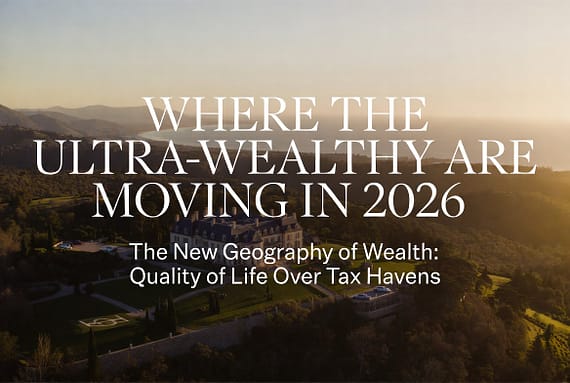
The New Geography of Wealth: Quality of Life Over Tax Havens
The private jet touched down in Lisbon at dusk. The passenger — a 47-year-old tech founder who had just closed a $4.2 billion exit — looked out at the Tagus River and said quietly, “I think I’m done chasing flags.”
He is not alone. In 2026, the global migration of the ultra-wealthy has reached an unprecedented scale, but the motivations have fundamentally shifted. The old playbook — zero-tax jurisdictions, golden visas, perpetual sunshine — is being replaced by a more nuanced search: for stability, privacy, community, education, and long-term resilience in an increasingly uncertain world.
According to the Henley Private Wealth Migration Report 2025 (published June 2025 with 2026 forecasts), a record 142,000 millionaires relocated internationally in 2025, with projections rising to 165,000 in 2026 — the largest annual movement of private wealth ever recorded. This follows 134,000 in 2024 and 120,000 in 2023, marking a sustained structural trend rather than a post-pandemic blip.
UBS’s Billionaire Ambitions Report 2025 (December 2025) adds critical depth. Global billionaire wealth hit a record $15.8 trillion, up 13% in a single year. The number of billionaires grew 8.8% to nearly 3,000, driven by 196 new self-made billionaires who added $386.5 billion in wealth. At the same time, 91 heirs inherited a record $297.8 billion — 36% more than in 2024 — accelerating the greatest intergenerational wealth transfer in modern history.
The top drivers cited by UBS are revealing:
- Quality of life and family well-being (41%)
- Geopolitical and climate stability (37%)
- Ability to organize tax affairs more efficiently (35%)
Tax optimization remains important, but it is no longer the dominant factor. Families who have already built or inherited enormous wealth are now prioritizing places where they can actually live well for decades.
The Shifting Global Map
United Arab Emirates continues to lead in raw inflows. Henley projects another 9,800 millionaire arrivals in 2026, cementing Dubai and Abu Dhabi as the top destination for entrepreneurs and crypto investors. Zero personal income tax, golden visas, and world-class infrastructure remain powerful draws. However, newer arrivals are demanding longer-term family planning options and international schools, signaling a maturing market.
Portugal, Greece, and Italy form Europe’s lifestyle “Golden Triangle.” Portugal’s Golden Visa program (despite adjustments) and Italy’s flat-tax regime for new residents continue to attract families from the UK, Germany, and the Middle East. Buyers are increasingly choosing inland areas — Tuscany, the Douro Valley, and the Peloponnese — for space, privacy, and lower density than the overcrowded coastal hotspots of the early 2020s.
Singapore and Switzerland hold steady for high-net-worth individuals seeking rule of law, elite education, and political neutrality. Singapore remains the premier Asia-Pacific gateway; Switzerland retains its status as the gold standard for discretion and security.
The United States attracts strong inflows (projected +7,500 millionaires in recent data), particularly through opportunity, innovation ecosystems, and the EB-5 program. Florida and Texas still dominate volume, but a more discerning cohort is seeking four distinct seasons, top-tier private education, and lower exposure to extreme weather events.
The New Calculus
For the next generation of billionaires (under 55), the decision matrix has evolved. UBS data shows they are far more willing to accept moderate taxation in exchange for better schools, cleaner air, stronger communities, and reduced exposure to climate and political risk.
They want homes that feel like sanctuaries rather than showrooms. They want passports that open doors but also communities that close them when needed. They want legacy that outlasts the next tax regime or geopolitical shock.
This explains the rise of “quiet luxury” destinations — places that rarely top raw inflow charts but are winning the hearts (and capital) of families who have already succeeded. These enclaves share a profile: political stability, excellent private schooling, access to nature, privacy through geography, and a cultural emphasis on discretion over display. They are places where wealth can put down roots without constantly performing.
The Road Ahead
The great wealth migration of 2026 is less about optimization and more about alignment — aligning capital, family, and future in places that still feel like home in a world that rarely does.
The ultra-wealthy aren’t just relocating anymore. They are choosing where their story continues.
Sources (all accessed March 6, 2026)
- Henley & Partners, Private Wealth Migration Report 2025 (June 2025) and 2026 forecasts — https://www.henleyglobal.com/publications/henley-private-wealth-migration-report-2025
- UBS, Billionaire Ambitions Report 2025 (December 2025) — https://www.ubs.com/global/en/wealthmanagement/family-office-uhnw/reports/billionaire-ambitions-report-2025.html
- New World Wealth / Henley & Partners, Country Wealth Flows and Global Wealth Migration data (2025–2026 projections)
- Knight Frank, The Wealth Report 2025 (February 2025) — supporting mobility and lifestyle trends
