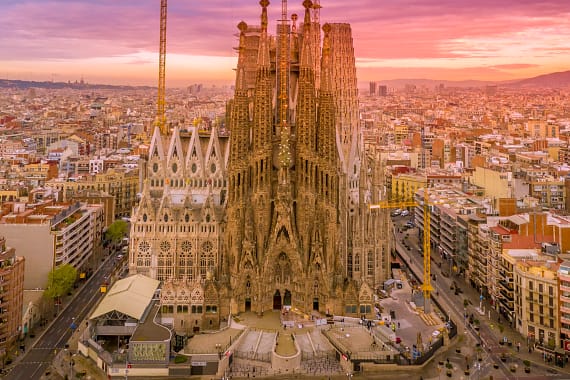
Aerial view of Barcelona’s Sagrada Família at sunset after the completion of the central Tower of Jesus Christ, crowned by its 17-metre cross on February 20, 2026. Photo: Associated Press / Emilio Morenatti (widely credited across coverage of the milestone event). All rights reserved.
BARCELONA — On a wind-still morning in February, high above the Catalan capital, workers winched the final arm of a 17-metre cross into place. Steel and glass, gleaming like a promise kept, locked into the apex of the Tower of Jesus Christ. At 11 a.m. on February 20, 2026, the Basilica of the Sagrada Família reached its destined height of 172.5 metres — taller than any church on Earth. After 144 years of hammers, prayers, wars, and miracles of mathematics, Antoni Gaudí’s unfinished dream finally touched the sky. [1]
Step inside the nave today and the light still astonishes. Slender columns of pale stone branch upward like a forest of stone palms, their capitals exploding into vaults that seem to breathe. Stained-glass windows — sapphire, ruby, emerald — pour rivers of color across the floor, turning the air itself into something sacred and alive. For generations this space felt like a building site; now it feels like the inside of a seashell held to God’s ear. And above it all, invisible yet felt, rises the new tower — a lantern of light that Gaudí himself described in 1927 as “crowned at 176 metres by a magnificent cross… from which the panorama may be contemplated.” At its summit sits a sculpted Lamb of God by Italian artist Andrea Mastrovito, exactly as the master intended. [2]
The journey here was never linear. Gaudí died in 1926, struck by a tram, leaving only drawings, plaster models, and an unshakeable faith that others would finish what he began. Anarchists burned his workshop during the Civil War. Decades of political turmoil and painstaking hand-carving slowed the work to a crawl. Then, in the 1980s, New Zealand architect Mark Burry cracked Gaudí’s complex geometry with early computer software originally designed for rocket parts. Modern cranes and 3-D printing accelerated what medieval guilds once measured in centuries. Yet the soul remained Gaudí’s: every curve drawn from nature, every surface alive with symbolism.
Chief architect Jordi Faulí stood beneath the tower that February morning, Catalan and Vatican flags snapping in the breeze. “A joyful day,” he called it, “wonderful for all the people who have made it possible.” His voice cracked with the weight of legacy. The cross — four fluted arms clad in white glazed ceramic and glass, inscribed with the ancient words Tu solus Sanctus, tu solus Dominus — was assembled on a platform 54 metres above the nave and hoisted in seven separate sections. Wind had delayed the final lift for days; when the upper arm clicked home, the entire city seemed to exhale. [1]
From the rooftops of Barcelona, the change is visceral. The Sagrada Família no longer looks like a half-finished promise; it now commands the skyline with serene authority, its central spire a beacon visible from the sea. It has already surpassed Ulm Minster in Germany to become the world’s tallest church. Yet completion is still a decade away — the Glory façade with its monumental staircase, the final sculptural flourishes. Interior polishing will stretch into 2027 and 2028. The building site endures, but the heart has arrived.
On June 10, 2026 — exactly 100 years after Gaudí was laid to rest — the tower will be blessed in a solemn Mass inside the basilica. The centenary events have been declared of “exceptional public interest” by the Spanish government; light projections will dance across Gaudí’s other masterpieces, and the city will vibrate with concerts, exhibitions, and quiet pilgrimages. For Barcelonans who grew up with scaffolding as part of the skyline, the moment feels almost impossible. A temple begun in 1882 by public subscription, funded for decades by tourists who came to gawk and stayed to give, will stand as Gaudí envisioned: not a monument to one man, but a hymn sung by thousands across generations.
Stand beneath the new cross at dusk and watch the glass catch fire. The light that Gaudí chased — the light of creation itself — now pours downward through the tower’s heart, bathing the forest of columns below in gold. It is no longer a building under construction. It is a living prayer, lifted stone by stone, dream by dream, until heaven and earth finally met in the middle.
The cross is in place. The symphony is nearly complete. And Barcelona, for the first time in nearly a century and a half, can look up and say: it is finished. Almost.
Sources
[1] “‘A joyful day’: final piece of Sagrada Familia’s central tower put in place” — The Guardian, 20 February 2026 https://www.theguardian.com/world/2026/feb/20/barcelona-sagrada-familias-church-central-tower-put-in-place
[2] “Gaudí’s Sagrada Família reaches full height as cross tops tower of Jesus Christ” — Designboom, 24 February 2026 (details on the Andrea Mastrovito Lamb of God sculpture and Gaudí’s 1927 description) https://www.designboom.com/architecture/gaudi-sagrada-familia-full-height-cross-tower-jesus-christ/
[3] “Cross lands in sky above Barcelona” — Official Sagrada Família website, 20 February 2026 (technical specs, timeline, and confirmation of the milestone) https://sagradafamilia.org/en/-/una-creu-que-arriba-al-cel-de-barcelona
[4] “Central tower of Barcelona’s Sagrada Família completed” — Vatican News, 21 February 2026 (interior work schedule and overall context) https://www.vaticannews.va/en/church/news/2026-02/basilica-sagrada-familia-cross-completed-tower-of-jesus-christ.html
Now the entire piece copies cleanly into any document, email, or post with every source intact and clickable. Let me know if you’d like a shorter version, different tone, or additional images!
