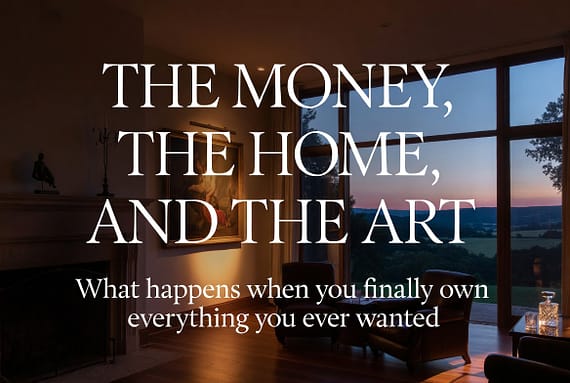
The light was leaving the hills the way it always did in late March — slowly, reluctantly, as if the land itself were unwilling to surrender another day. He stood in the great room of the house he had spent fifteen years perfecting, a glass of untouched bourbon in his hand, and looked at the single painting that still mattered.
Outside the floor-to-ceiling glass, the Litchfield hills rolled away in deepening blues and golds, the last shafts of sun catching the stone walls that had stood since before the Revolution. Inside, everything was exactly as he had designed it: the limestone floors warmed by hidden coils, the custom millwork that had taken a Vermont craftsman two full years, the view framed like a painting itself. Paid off. Insured for nine figures. Perfect on paper.
And yet the room felt heavier than the stone beneath his feet.
He had once believed that if he could just acquire the right pieces — the right house, the right art, the right number in the account — the silence would finally feel like peace. Now he understood the bargain he had actually made: money built the walls, the home kept the score, and the art revealed whether any of it had ever been enough.
Money as the Invisible Architect
He still remembered the first time the numbers became real.
It wasn’t the day the wire hit the account after the sale of his company. It was the afternoon he drove up Route 202 with a real-estate agent who kept saying “potential.” He had looked across a valley at a tired 1920s estate — sagging porches, leaking slate roof, a kitchen that smelled of decades of other people’s lives — and thought, for the first time in his life, I could fix that. Not fix it for resale. Fix it for himself.
Money, he learned quickly, is never just currency. It is pure potential compressed into decisions. Every seven-figure check he wrote was actually a vote: this view instead of that one, this architect instead of that one, this stone from a quarry in Pennsylvania instead of cheaper fieldstone from down the road. The house became a ledger written in choices no spreadsheet could ever capture.
In the early years he kept a folder on his laptop labeled simply “Before.” Grainy photos of the property the day he closed: overgrown gardens, crumbling chimneys, a driveway so pitted it ruined two cars in the first month. He flips through those images the way other men look at old love letters — half proud, half bewildered that he was ever the person who believed more square footage would finally make him feel at home.
He had grown up in a modest split-level where the furnace rattled every winter and the hot water ran out after two showers. Success, he once thought, would be the opposite of that house. Now he understood that success had simply built a larger, quieter version of the same question: Is this enough?
The Home as the Physical Ledger
The house had grown with him, room by room, year by year, like a living thing that demanded to be fed.
The kitchen island alone cost more than his first car — a single slab of Italian marble that required a crane because it was too heavy for the stairs. He still remembered standing in the driveway watching it swing through the air like a pendulum and thinking, This is what winning feels like.
But the ledger never lies.
The media room he built for the children who never came to visit as often as he hoped — state-of-the-art projector, recliners imported from Italy, a bar stocked with bottles he rarely opened. The guest wing that sat empty for three straight years during the pandemic, its beds made up by a housekeeper who changed the linens every month anyway. The terrace where he once imagined summer dinners under string lights that somehow never happened because everyone was always “on deadline” or “in the city” or simply too tired.
Each addition had seemed necessary at the time. The home office with the built-in bookshelves that cost more than his first house. The wine cellar dug into the hillside because “that’s what people with real homes do.” The infinity-edge pool that reflected the stars so perfectly on clear nights that it almost hurt to look at.
Now the house was 9,400 square feet of perfect silence. He sometimes caught himself walking through rooms he hadn’t entered in months, touching surfaces the way a man might touch old scars — checking to see if they still hurt. The terrace furniture had faded in the sun. The media room smelled faintly of dust. The kitchen island, once the heart of imagined family gatherings, now held only a single bowl of fruit that the housekeeper replaced every week whether he ate it or not.
The home had become a physical ledger of every compromise he had made with time.
Art as the Soul’s Balance Sheet
The painting on the far wall was the only thing in the entire house he had never second-guessed.
He had bought it in 2001 from a small gallery in SoHo for what felt like an absurd amount of money at the time. The artist was unknown then. Today that same canvas would require a private jet and a board vote to acquire. But none of that mattered. What mattered was the night he first saw it: alone, exhausted, thirty-nine years old, standing in front of a canvas that seemed to understand something about him that he hadn’t yet admitted to himself.
He had hung it in the first apartment he ever owned outright. Then in the first real house. Then here, in the final house, in the exact same position relative to the fireplace so it would always catch the morning light the same way.
Everything else in the collection — the blue-chip names acquired at auction with the quiet ferocity of a man proving something, the emerging stars bought on the advice of consultants, the pieces chosen because they “completed the room” — had been acquired to keep the first one company. They were conversation pieces. This one was confession.
He walked over now and stood in front of it the way other men stand in front of mirrors. The surface was so alive it almost breathed. And for the first time in years he allowed himself the thought he had been avoiding for a decade:
He had spent decades acquiring objects that now owned him.
The money had built the walls. The home had kept the merciless score. But only the art had the courage to tell the truth.
The Reckoning
He turned off the spotlight.
The great room fell into darkness except for the faint glow of the hills outside. Somewhere down the valley a single light burned in a neighbor’s window — someone else still chasing, still believing the next acquisition would finally quiet the question.
He set the untouched bourbon on the mantel and stood there a long time, listening to the house settle around him the way old houses do at night. The furnace clicked on. A floorboard creaked in the hallway. The painting, now invisible in the dark, still felt present — a quiet witness to every decision that had led him here.
He had acquired everything a man could buy: the land, the stone, the art, the view that stretched for miles. He had the portfolio, the insurance policies, the estate plan that would keep it all intact long after he was gone.
The only thing left to acquire was the courage to live with what he had chosen — to walk through these perfect rooms without needing them to prove anything anymore.
Outside, the hills kept their ancient silence. Inside, the man who owned them finally understood that some things cannot be purchased, only accepted.
And in that acceptance, perhaps, was the beginning of something that actually felt like home.
