
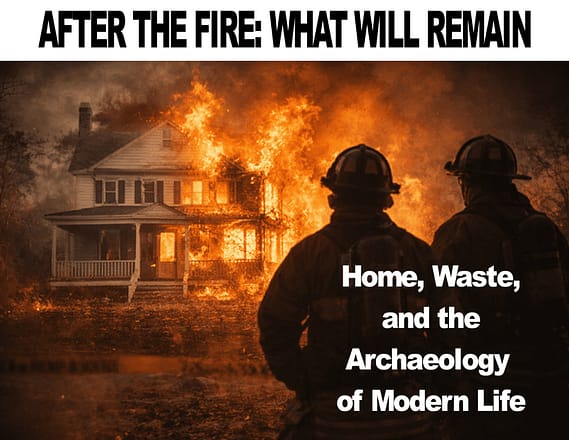
Home, Waste, and the Archaeology of Modern Life
From Sanctuary to Condemned: Lessons from the Ashes on Building Safer, Sustainable Communities
In Anytown, Connecticut, the air around the hollowed shell of a home still carries the chemical signature of a tragedy. The April 2025 fire didn’t just claim a roofline; it took the lives of a mother and her eight-year-old daughter, leaving behind a neighborhood haunted by a familiar silhouette that now mimics life while teetering on collapse. From the curb, the windows still frame empty rooms, but inside, the structure is waterlogged and smoke-scarred—a sanctuary transformed into a hazard by an assault it was never meant to endure.
In that instant, the building transformed—from a haven of memories to a condemned hazard, overseen by engineers, insurers, and officials. No longer a place of refuge, it demands careful deconstruction. By the time Stephen Schappert arrives, entry is forbidden. Schappert is now managing the process of bringing the home back to life. The structure teeters on instability, especially the third floor, where every step risks collapse. Fire ignited the crisis; now, bureaucracy, costs, and hidden dangers dictate the path forward—raising the unspoken question: What, if anything, can truly be salvaged?
Yet from these ashes, lessons emerge. This is not just a story of loss, but a call to honor the mother and daughter by rethinking how we build: embracing life-promoting principles that prioritize resilience, sustainability, and safety to prevent future heartbreak and foster stronger communities.
Fire is the initiating event. Everything that follows flows from it—permits, protocols, price swings, and the question nobody wants to ask out loud: what, exactly, is safe to save?
“Yet from these ashes, lessons emerge. This is not just a story of loss, but a call to honor the mother and daughter by rethinking how we build: embracing life-promoting principles that prioritize resilience, sustainability, and safety to prevent future heartbreak and foster stronger communities.” – Schappert

Insurance files are open. Engineers tread carefully, prioritizing assessments over assumptions. Town hall demands a plan that minimizes new risks, while the owner yearns for momentum amid the standstill. Everyone hovers in limbo, awaiting a breakthrough.
The initial exploration leaned toward modular replacement—a seemingly ideal solution on paper: factory precision, controlled quality, and limited on-site hazards. Demolition appeared routine, with an early quote of $70,000 reflecting that optimism.
Yet that figure was built on partial truths. The fire had unearthed perils embedded in the home’s history: lead paint, asbestos insulation, and floor tiles that had slumbered harmlessly for decades until heat and water mobilized them into threats.
Once activated, these hazards reclassified the demolition as a “hot load,” a detail that surfaced only at the permit desk in town hall, ballooning the cost to $115,000—not due to added labor, but the stark confrontation with overlooked dangers.
“Asbestos-related diseases can take decades to show up. And whether or not you develop a disease depends on how long you were exposed and how intense that exposure was.” — Humberto Choi, MD, Pulmonologist at Cleveland Clinic.
The realization arrived neither in the fire’s immediate aftermath of April nor the evaluations of November, but precisely when the contractor filed the paperwork.
“This should have been flagged during the first December walkthrough,” Stephen says.
Another month had vanished.
While demolition pricing stalls, the modular plan quietly unravels. Stephen does what he has done throughout his career: he pressure-tests assumptions. He sources additional factory and builder quotes. He studies not just the house, but the site around it—the logistics no brochure can fix.
The Modular Setback
Stephen surveyed the overhead electrical lines and the narrow street geometry, quickly recognizing that modular construction was logistically unfeasible. No marketing materials could overcome the lack of space to stage factory-built units; the promise of seamless pre-fab assembly clashed irreconcilably with the constraints of a 19th-century neighborhood.
Modular replacement is set aside. On-site construction emerges as the only practical path. Stephen takes the lead in coordinating permits, demolition sequencing, builder sourcing, financing alignment, and communication among the owner, insurance, and town hall.
A brief exchange with a building official shifts the momentum: “Steve, it’s reassuring that you speak our language.” What he means is not just terminology—it’s process.
The next question is how the building comes down.
There is debate. Manual demolition sounds careful. Mechanical demolition sounds aggressive. The reality is neither—and both.
In a condemned, fire-damaged structure, a hybrid approach is the safest path: limited manual work to disconnect utilities and address specific hazards, followed by mostly mechanical demolition to minimize time inside the building.
The longer people are inside, the greater the risk. Lead dust. Asbestos fibers. Floors weakened unevenly by heat and water. Especially above grade—especially on the third floor—unpredictability replaces structure.
“If something is going to move,” Stephen says, “you want no one standing on it when it does.”
The Neighbor’s Relief
The neighbor on the porch didn’t cry for the house; she cried for the fence. For months, she had watched her seven-year-old eye the caution tape, terrified that the “invitation” of a broken building would lure her children into the dust. As Stephen secured the perimeter, the emotional weight of the site shifted—it was no longer a monument to loss, but a localized threat finally being neutralized so a neighborhood could breathe again.
Any demolition—manual or mechanical—will transmit vibration. That matters because beneath the house is a foundation built for gravity, not movement: massive fieldstone at the base, with brick above. Stephen’s assessment is blunt: there is roughly a ten percent chance it survives demolition intact.
Not because it was poorly built, but because it was never meant for this.
And even if it survives, it fails the future. A new structure must meet modern building codes—continuous load paths, anchoring, lateral resistance. The old foundation does not come close.
Insurance looks backward, at what existed before the fire. Building codes look forward, at what must exist next to protect life. When those two timelines collide, nostalgia becomes a liability, Schappert says.
Architecture critic Ada Louise Huxtable warned decades ago that preservation divorced from judgment risks turning history into sentiment rather than stewardship. Saving a structure, she argued, only matters if it serves life in the present.
Fire forces the choice.
Demolition permits are now days from approval. A spring rebuild is planned. Stephen is helping coordinate design, financing, and construction of the new structure.
But before anything is rebuilt, there is this moment.
The pause between damage and correction.
The interval where decisions become visible.
“I’ve spent my life studying buildings,” Stephen says. “Not just how they’re built—but why.”
He calls it a forensic investigation of civilization.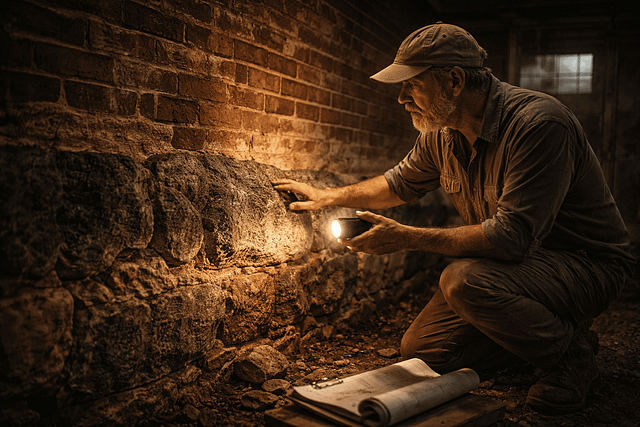
Not crime scenes.
Structures.
How materials were chosen.
What assumptions governed repair versus replacement.
Which layers expected return—and which assumed erasure.
This house did not fail because it was old.
It failed because a fire activated everything that had been layered into it over time.
Standing outside the safety perimeter, Stephen looks at what remains.
“This,” he says, “is where you learn what a culture actually understands about its homes.”
Not when everything works.
But when a building breaks—and forces the truth into the open.
The Ghost in the Mix
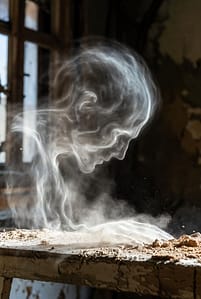 The dust inside the Anytown house settles slowly, but it never really leaves.
It migrates—into the grain of old wood, into the seams of work gloves, into the pores of masonry that has been absorbing weather for a century.
Dust is the afterlife of materials. It’s what remains when a home stops being a shelter and starts becoming evidence.
“Every building leaves a ghost,” Stephen says. “You just have to know where to look.”
He doesn’t stop at the foundation because it’s failing. He stops because it’s layered—like a site that has been repaired, raised, adapted, and patched by different eras with different assumptions.
At the base, massive fieldstone presses directly into the soil—irregular, heavy, built for compression rather than perfection. Above it, the material changes. Brick rises in measured courses, smaller and more exact, laid where framing needed a level line to begin.
“This is where the logic shifts,” Stephen says.
 Ground-Time vs. Carpentry-Time
 Ground-Time vs. Carpentry-Time
Stephen runs a hand over the massive fieldstone base, feeling the “ground-time” of a foundation built to breathe with the earth. Above it, the logic shifts to “carpentry-time”—exact brick courses laid for the precision of a sill. This wasn’t a luxury build; it was a conversation between stone and wood that modern concrete, now spider-webbed with hairline cracks, has forgotten how to have.
The combination raises questions the way old walls always do.
It even reminds Stephen—visually, not causally—of the way ancient sites sometimes show two different “logics” stacked in one place:
larger, older stonework below; smaller, more standardized work above. Not the same reason. Just the same feeling: time built in layers.
What came later did not share that patience.
Concrete appears where earlier materials gave way—poured decades after the original work, introduced as a fix rather than a continuation. Its surface is already spider-webbed with hairline cracks, fractures easy to dismiss until you understand what they represent:
stress, moisture, and time moving faster than the material was asked to move.
Stephen taps the concrete with his knuckle. The sound is sharp. Final.
“This,” he says, “was never designed to heal.”
The phrase—never designed to heal—becomes the hinge.
Because there was a time when buildings were made with the expectation of injury. Cracks were anticipated. Movement was normal. Materials were chosen not to resist time completely, but to respond to it—quietly, repeatedly—without requiring total replacement.
This foundation still remembers that logic. The newer materials do not.
We often describe that loss as financial necessity—a byproduct of building for the bottom line.
But the deeper truth is cultural: we stopped designing for return.
We stopped building as if anyone would come back—our neighbor, our kid, our future self—to repair what time inevitably touches.
Rome and the expectation of return
Nearly two thousand years ago, Roman builders poured concrete that still refuses to behave like ours.
They did not have Portland cement. They did not rely on steel reinforcement.
What they had was volcanic ash (pozzolana), quicklime, and a method refined through practice.
Researchers have described one key technique as hot mixing—introducing lime at high temperature, producing bright mineral “clasts” that can remain chemically active after the concrete cures. When cracks form and water enters, those inclusions can react, precipitating new minerals that help seal fissures.
The material could, in a limited but real way, heal itself.
This is not metaphor. It is chemistry.
The modern explanation of this process owes much to Admir Masic and collaborators, whose work helped clarify why Roman concrete behaves so differently from modern mixes. Their findings suggest Roman structures were not inert after construction; they continued interacting with their environment over time. “The Pantheon would not exist without the concrete as it was in the Roman time… They knew that was a great material, but they probably didn’t know that it would last thousands of years.” — Admir Masic, MIT Professor of Civil and Environmental Engineering.
“You don’t design a material like that,” Stephen says, “unless you assume someone is coming back.”
The Pantheon—still crowned by the largest unreinforced concrete dome in the world—
is not only engineering. It is expectation made physical. It assumes time will pass and the building will still matter.
The Roman Indictment
Modern concrete makes a different assumption. It is optimized for speed, uniformity, and short-term performance. It performs beautifully—until it doesn’t. Water gets in. Steel corrodes. Cracks propagate instead of closing. Unlike the Roman Pantheon, which utilized “hot mixing” to create a material that could chemically heal its own fissures, the concrete at the Anytown site is optimized for a single moment in time. It performs beautifully until it doesn’t, at which point the steel corrodes and the cracks propagate. The difference isn’t in our technology, but in our intent; we stopped building for the person who might come back to repair it.
“What changed,” Stephen says, “wasn’t knowledge. It was intent.”
Lascaux: permanence without engineering
If Roman concrete represents engineered endurance, the caves of Lascaux represent something stranger: permanence without ambition.
The painters who entered those caves did not calculate load paths or chemical reactions.
They ground minerals—hematite, goethite, charcoal—into powders and bound them with what the landscape provided:
fat, water, plant resins. They painted animals directly onto limestone walls shaped by geological time.
What made those images last was not mastery, but alignment.
The cave offered darkness, stable humidity, and isolation. The pigments bonded naturally to mineral surfaces. There was no expectation of renovation, no impulse to update. The wall was not a backdrop. It was the work.
Seventeen thousand years later, the ochres remain legible.
Stephen has never been to Lascaux, but he speaks of it the way other builders speak of cathedrals.
“Those artists didn’t separate art from structure,” he says. “That’s the whole point. The wall was the art.”
He gestures back toward the Anytown interior, where drywall has been removed in sheets and stacked like refuse.
“Our walls are skins,” he says. “They’re not meant to carry meaning. They’re meant to carry finishes.”
Designer paint peels in five years. Wallpaper delaminates. Trends cycle faster than materials can age.
Even when we aim for beauty, we rarely aim for survival.
The contrast is uncomfortable.
“How did a so-called primitive civilization outlast us aesthetically,” Stephen asks, “and why does that make us defensive instead of curious?”
The presumption of touch
Behind chestnut lath, Stephen finds evidence of repair—small patches where plaster was reworked rather than replaced. A hand-forged nail from earlier is not an accident. It belongs to a system that assumed maintenance.
He says it more quietly this time:
“Back then, you built like someone would be back in this room. Your neighbor. Your kid. You.”
That presumption—the expectation of return—changes everything.
It changes how thick a wall is. It changes whether a joint is hidden or celebrated. It changes whether damage is catastrophic—or instructive. Roman concrete assumed cracks would come—and prepared for them.
Lascaux assumed the wall would remain—and committed fully to it.
Modern construction assumes something else entirely.
“The flip,” Stephen says.
The flip is not just a real estate strategy. It is a worldview.
It treats buildings as transitional, stewardship as temporary, value as something extracted rather than accumulated.
“You can’t build for inheritance and resale at the same time,” he says. “Eventually, one of them wins.”
A civilization that mastered chemistry—and abandoned it
The most unsettling realization, Stephen believes, is that our

impermanence is not the result of ignorance.
We know how to make concrete that lasts longer.
We know how to specify materials that can be repaired.
We know how to design interiors that evolve rather than reset.
We choose not to.
Because the systems around us—financing, development timelines, content cycles, consumer psychology—reward speed.
They reward novelty. They reward the after photo more than the afterlife.
“We’ve turned permanence into a liability,” Stephen says. “That’s new.”
In Rome, endurance was prestige. In Lascaux, it was accidental grace. In the modern West, permanence is often framed as inflexibility—something to be avoided even when “adaptability” produces mountains of waste.
Stephen stands and brushes the dust from his hands. The cracked foundation remains as it is.
It will be reinforced, patched, concealed. The wall will look sound again.
But the ghost will remain.
“There’s nothing wrong with change,” he says. “What’s wrong is pretending change has no cost.”
That cost is written in cracks that widen instead of close. In pigments that fade instead of mineralize.
In interiors that leave no readable trace behind for anyone to study.
If future archaeologists stand where Stephen stands now, they may not find beauty in our walls.
They may not find craft. They may not even find legibility.
What they will find is evidence of choice.
And in that choice—in the gap between what we knew how to do and what we decided to do—
the story of our civilization will begin to take shape.
“In sustainable construction, it’s essential that we adequately ensure fire safety.” — Ruud van Herpen, part-time professor at TU/e and fire safety consultant at Peutz
The Cult of the “After”
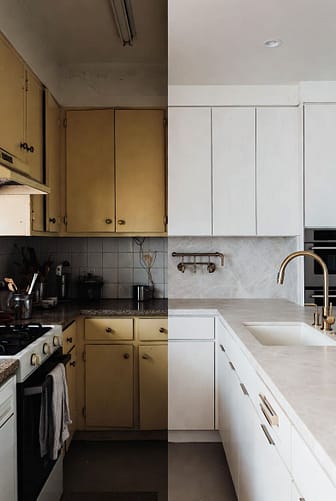
The most enduring architectural monument of the twenty-first century isn’t a skyscraper or a museum. It is a digital diptych: the before-and-after.
In these images, the before is always framed as an apology. It is a space of dim compromises—yellowed cabinetry, dated tile, and a cramped layout that seems to shrink under the weight of its own obsolescence. Then comes the after.
It is a room purged of specificity and disciplined into a clinical, white-oak coherence. Flooded with a manufactured light, it features soft stone and brass fixtures that signal a warmth entirely devoid of history. The transition is presented as frictionless, a magical evolution where nothing of value is lost.
Stephen Schappert has spent enough time in the wreckage to distrust that magic.
“They never show you what actually left the room,” he says, his thumb hovering over a glowing screen.
“Refuse what you do not need; reduce what you do need; reuse what you consume; recycle what you cannot refuse, reduce, or reuse; and rot (compost) the rest.” — Bea Johnson, zero-waste advocate and author of Zero Waste Home
He scrolls through the forensic record of a recent project: a kitchen that was executed not because it had failed, but because it had simply aged out of the algorithm. The granite countertops were monolithic and unyielding; the cabinets were custom-built to last a century; the appliances were in the prime of their mechanical life. To the landfill, they are just “debris.” To the homeowner, they were an embarrassment.
“If it can’t be reduced, reused, repaired, rebuilt, refurbished, refinished, resold, recycled, or composted, then it should be restricted, designed or removed from production.” — Pete Seeger, musician and environmental activist
The Violence of the “After”
“All of this,” Schappert says, gesturing to the splintered remains on his screen, “was once someone else’s dream. It was their ‘after.’”
We have elevated the home renovation from a matter of maintenance to a central ritual of contemporary life. The “after” photo is our modern proof of agency—a small, brightly lit assertion of control in an increasingly unruly world. But this ritual demands a sacrifice. The image circulates through our feeds faster than the work itself, and certainly faster than the dust can settle, rewarding the total erasure of the past.
Like all rituals, it carries a cost we are only beginning to calculate: a home that no longer remembers its own story.
“Architecture should speak of its time and place, but yearn for timelessness.” — Frank Gehry, renowned architect
The aesthetic of timelessness—and its speed
No one normalized the language of timeless interiors more effectively than designers who understood mass media. Among them, Shea McGee emerged as a defining figure of the era—not because her work was radical, but because it was reassuring.
Her interiors promised calm: neutral palettes, natural textures, restraint. Homes that felt collected, livable, enduring. The message resonated in a culture saturated with noise.
But Stephen sees the paradox.
“We started chasing the look of permanence instead of permanence itself,” he says.
The McGee-style interior—warm minimalism, classic silhouettes, softened contrast—was positioned as an antidote to trend churn. In practice, it often accelerated it. Because when timelessness becomes a style rather than a structure, it ages like any other.
The shade of white shifts.
The wood tone warms or cools.
The brass loses favor.
Suddenly, a room designed to look eternal is once again provisional.
“We wanted the aesthetic of antiquity,” Stephen says. “Without the commitment.”
In earlier eras, timelessness was not an aspiration. It was a consequence. Stone, plaster, limewash, wood thick enough to move slowly. You did not update those materials casually. You lived with them. You repaired them. You let them darken, crack, and soften into themselves.
Now, timelessness arrives prepackaged—and expires on schedule.
Renovation as content
 The after photo does not exist in isolation. It belongs to an ecosystem.
Renovations are no longer private decisions. They are performative acts, documented step by step for an invisible audience. Progress shots. Reveal videos. Swipe-through transformations. The home becomes a narrative arc rather than a shelter.
“What you’re really renovating,” Stephen says, “is your place in the feed.”
The pressure is subtle but relentless. A kitchen that functions perfectly well can feel inadequate when compared to an optimized image. A bathroom becomes embarrassing not because it fails, but because it signals the wrong moment in time.
This is not vanity in the simple sense. It is participation.
To remain visible—to remain legible—you must update.
Materials follow accordingly. Matte finishes photograph better than glossy ones that reveal wear. Thin veneers deliver visual impact without structural patience. Speed matters more than depth.
The after photo rewards immediacy.
Archaeology rewards endurance.
The two are incompatible.
The economics of erasure
On another site, Stephen watches a high-end kitchen being dismantled. The cabinets are solid wood. The countertops granite, veined and heavy. They were installed less than fifteen years ago.
“They’re the wrong gray,” the homeowner says, almost apologetically.
Stephen does the math without trying. Thousands of dollars of material. Countless hours of labor. All of it headed for a landfill because color theory moved on.
“This isn’t design failure,” he says later. “It’s economic success.”
The renovation industry thrives on turnover. Financing structures favor replacement over repair. Labor costs make salvage difficult. Time pressure makes patience irrational. It is often cheaper to demolish and rebuild than to adapt.
Disposability is not a personal failing. It is a system operating as designed.
What unsettles Stephen is how completely this logic has colonized the home—the space we still call a sanctuary.
The domestic confession
Homes have always been more honest than monuments. While public structures are built to project a specific image, archaeologist Lisa C. Nevett argues that domestic spaces serve as “confessional environments”—intimate stages where our true values surface in the quiet patterns of daily life.
If this is true, our modern sanctuaries are confessing a profound unease with time. What does it say about us that we design our most private spaces for total erasure?
We see the “confession” in the violence of the renovation:
-
The room where children took their first steps is gutted because a backsplash has fallen out of fashion.
-
A solid kitchen table is exiled to the curb because its wood tone no longer coordinates with a new floor.
-
The literal marks of living—the scuffs, the worn paths, the record of presence—are treated as defects to be sanded away rather than evidence of a life well-lived.
Stephen Schappert does not romanticize the drafty, inefficient, and often unjustly distributed homes of the past. But he recognizes that they were built on an assumption of continuity that we have largely abandoned.
“We’ve confused flexibility with disposability,” he says, watching a demo crew clear a path for the new. “They aren’t the same thing. A flexible system adapts by leaning on its history; a disposable one simply starts over.”
Our current interiors, governed by the speed of the “after” photo, have overwhelmingly chosen to start over.
The emotional cost of the “after”
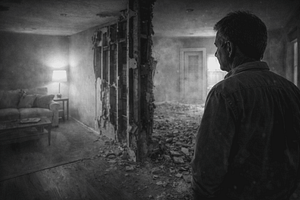
There is a psychological toll to living in spaces that are never allowed to settle.
When nothing is meant to last, attachment becomes risky. When surfaces are temporary, memory has nowhere to land. The home becomes a stage set—beautiful, controlled, and strangely thin.
Stephen has seen it in clients who renovate compulsively, always chasing the next version of calm. He has felt it himself, standing in rooms stripped of their past, wondering what—if anything—should be saved.
“We’re exhausted,” he says. “And we keep renovating like that will fix it.”
The after photo promises resolution.
The demolition dust promises renewal.
What neither promises is endurance.
What the after leaves behind
Future archaeologists will not see our after photos. They will see what survived them.
They will find the byproducts of renovation velocity: layers of waste, mixed materials, chemical residues. Evidence of constant replacement—and little evidence of care.
They may infer a civilization obsessed with improvement but uneasy with aging. A people who valued control over continuity.
Or they may notice the anomalies.
The repaired cabinet.
The salvaged beam.
The room adapted instead of erased.
Those will stand out.
Not because they were common—but because they resisted the cult.
Stephen scrolls past another transformation image and locks his phone.
“The problem with the ‘after,’” he says, “is that it pretends the story is over.”
But buildings, like civilizations, do not end cleanly. They accumulate. They remember.
The question is whether we allow them to.
The Technofossil Stratum
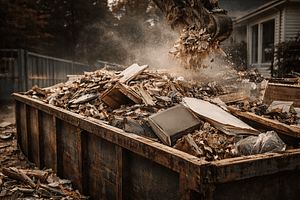 The things Stephen Schappert cannot save leave the site quietly.
They are loaded into dumpsters without ceremony—splintered drywall, cabinets reduced to shards, laminate flooring snapped into manageable lengths. The debris is anonymous now, stripped of address and memory. It will not be photographed. It will not be mourned.
“It looks like nothing,” Stephen says, watching the container fill. “That’s how you know it’s dangerous.”
The truck pulls away from the Anytown site carrying the residue of a dozen decisions made over decades. Stephen does not follow it. He already knows where it’s going.
Somewhere out of sight, the interior becomes geology.
From renovation debris to deep time
Landfills are not designed to be archives. They are engineered for containment—for isolation, compression, delay. But archaeology has never depended on intention. It depends on survival.
What enters a landfill today will not simply disappear. It will stratify.
Layer by layer, renovation waste accumulates into a record far more durable than the rooms it replaced. Plastics, adhesives, synthetic resins, treated woods, sealants—materials designed to resist decay—form a dense, chemically complex horizon in the soil. Unlike organic waste, they do not return cleanly to earth. They persist, fragmenting into smaller and smaller particles without ever fully leaving.
“This,” Stephen says, “is what we’re actually building to last.”
Archaeologists have a name for it now: technofossils—objects and materials produced by industrial societies that will persist in the geological record. Concrete. Plastics. Alloys. Chemical compounds. Not artifacts in the classical sense, but residues of systems.
Future excavators will not need to speculate about our habits. They will dig straight into them.
The archaeology of us
For most of its history, archaeology was a discipline of looking outward—a search for meaning in the distant, dusty remains of “them.” In recent decades, that lens has turned inward, transforming the modern world into its own excavation site. This shift, often described as the archaeology of the contemporary, treats our current existence not as a finished story, but as a forensic mystery in progress.
Among those defining this approach is Gavin Lucas, who suggests that our era will be marked less by the singular monuments we build than by the sheer material saturation we leave behind. In future strata, excavators won’t find the clean edges of a “classic” age; they will encounter a dense, unmistakable signature of synthetic permanence—layers rich in complex plastics, industrial composites, and chemical residues that defy traditional decay.
“Our era will be marked less by the singular monuments we build than by the sheer material saturation we leave behind… layers rich in complex plastics, industrial composites, and chemical residues that defy traditional decay.” — Gavin Lucas, archaeologist specializing in the contemporary past
“We aren’t just building homes; we’re creating a new geology,” Stephen says, his eyes tracing the jagged edge of a discarded laminate. “But it’s a geology that was never meant to be lived with, only discarded. We’ve engineered a legacy that is physically permanent but culturally invisible”.
The evidence is already surfacing. Microplastics—shredded from high-performance flooring, synthetic insulation, and weather-resistant textiles—have already infiltrated the local soil and water tables. These are the technofossils of the 21st century. They are active, mobile, and relentless, marking a moment in time where our mastery of chemistry outpaced our capacity for stewardship.
“Plastics will continue to be input into the sedimentary cycle over coming millennia as temporary stores—landfill sites—are eroded. Plastics already enable fine time resolution within Anthropocene deposits via the development of their different types and via the artefacts, known as ‘technofossils’.” — Jan Zalasiewicz, Emeritus Professor of Palaeobiology at the University of Leicester
Trash as testimony
Civilizations have always been defined by what they cast aside, but the legacy of a culture is determined by what that trash does next.
On the southern edge of Rome, a hill called Monte Testaccio rises as a monumental testament to ancient logistics. It is an artificial mountain composed almost entirely of millions of broken amphorae—the clay vessels once used to transport the empire’s olive oil. For centuries, Romans discarded these shards with a methodical precision, creating a massive, stable archive of their own consumption.
Archaeologists today prize this mound. The clay is inert, and its fragments are datable; the stamps on the handles reveal trade routes and the names of long-dead merchants. Even in its discarded state, the hill enriches the soil beneath it. Roman trash became a readable history that refused to poison its own future.
Our own waste will tell a much darker story.
The debris currently being hauled from Stephen’s site—a chaotic mix of PVC, chemical-heavy laminates, toxic foams, and treated lumber—possesses no such grace. It will not sort itself into tidy, readable layers for future scholars. Instead, it will coagulate into a “hybrid mass” that resists decomposition, confounds analysis, and actively complicates the surrounding ecosystems. It is a material that is as difficult to date as it is to remediate.
“Imagine trying to understand a civilization,” Stephen says, looking at the tangled heap of synthetics, “from materials that were never meant to be understood—or even remembered—at all”.
The silence of interiors, the noise of waste
The irony is sharp.
The most emotionally significant spaces of our lives—the rooms where we ate, slept, worked, worried—may leave almost no readable trace. The materials that carried those experiences dissolve, fragment, or vanish.
Meanwhile, the byproducts of renovation—the adhesives, polymers, coatings—will announce themselves across millennia.
“That’s the part that haunts me,” Stephen says. “We’re preserving the wrong things.”
The Floor That Lies
There is one renovation decision Stephen Schappert cannot watch without flinching.
Luxury vinyl plank installed over oak.
Not because it looks wrong—though it often does—but because it reveals, in a single gesture, how completely we have inverted our values.
“Oak can be four hundred years old,” Stephen says. “It has already outlived systems. Empires. Styles.”
The oak floor beneath many modern renovations is not decorative. It is structural history. Dense, slow-grown wood milled from forests that no longer exist, installed with the expectation that it would be sanded, repaired, lived with. It carries wear honestly. It darkens. It records footsteps.
It survives fire better than most modern finishes.
It can be repaired after flood.
It can be refinished again and again.
And we cover it.
Luxury vinyl plank promises efficiency: waterproof, scratch-resistant, affordable, visually convincing—at first. It photographs well. It installs quickly. It erases the inconvenience of maintenance.
“It looks fine for about six months,” Stephen says. “Then it starts telling the truth.”
The truth is chemical.
Vinyl flooring is a composite of plastics, stabilizers, fillers, and adhesives. It does not age. It degrades. It off-gasses. It fragments. When it fails, it does not become something else—it becomes smaller versions of itself.
In the archaeological record, oak becomes soil.
Vinyl becomes burden.
“We take a material that could last centuries,” Stephen says, “and bury it under something that will punish the world for millennia.”
The offense is not just environmental. It is temporal.
Oak belongs to long time. Vinyl belongs to short-term performance and long-term consequence. The decision to place one over the other is not neutral. It declares that surface matters more than substance, speed more than stewardship.
And then there is fire.
Stephen has seen what happens when synthetic flooring burns. The smoke is heavier. The chemistry more complex. The residues more toxic. The very thing marketed as durable becomes a multiplier of harm.
“People think they’re making an upgrade,” he says. “What they’re doing is introducing a failure mode.”
In a fire, oak chars.
Vinyl weaponizes the air.
Future archaeologists will not be confused by this choice. They will find the plastic layer intact long after the wood beneath it has returned to earth. They will see a civilization that covered its inheritance with convenience—and mistook that for progress.
“This isn’t about taste,” Stephen says. “It’s about respect.”
Respect for materials that already proved themselves.
Respect for time scales longer than a financing cycle.
Respect for the idea that some things don’t need improvement—only care.
Luxury vinyl does not make a home better.
It makes it quieter, faster, and easier to forget.
And forgetting, Stephen believes, is the most dangerous renovation of all.
Permanence without care
Technofossils represent a new kind of endurance: permanence without stewardship.
Roman concrete healed because it interacted with its environment. Lascaux pigments endured because they were aligned with it. Modern materials resist the world instead of participating in it. They persist, but they do not belong.
This distinction matters.
In older civilizations, endurance implied responsibility. If something lasted, it had to be maintained. If it failed, it could be repaired. Permanence was relational.
Technofossils sever that relationship. They last without care. They remain without meaning.
Stephen sees this as the great inversion of modern building.
“We couldn’t commit to walls,” he says. “But we committed to waste.”
Reading the layer
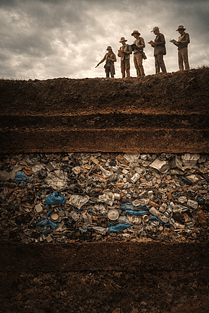 If future archaeologists cut a clean section through a modern landfill, they may identify a distinct band—a compressed horizon of plastics, concrete fragments, synthetic fibers, and chemical residues. It will mark the moment when human production outpaced human patience.
They may label it the early Anthropocene.
Or the age of acceleration.
Or something less flattering.
They will note that this layer coincides with unprecedented indoor living, rapid renovation cycles, and the disappearance of durable domestic craft.
They may wonder why a civilization capable of engineering self-healing materials chose instead to build interiors designed for erasure.
They may conclude that we mistook adaptability for disposability—and paid for it in silence.
What cannot be unbuilt
The truck that left Anytown hours ago has already dumped its load. The materials are compacted now, entombed with thousands of others like them. Stephen cannot retrieve them.
“This is the part you don’t get back,” he says.
But awareness, he believes, still matters.
Because the technofossil stratum is not finished forming. It grows with every demolition, every unnecessary replacement, every choice made for speed instead of care.
“We’re still writing this layer,” Stephen says. “The question is whether we know what we’re saying.”
The landfill will remember—
even if our homes do not.
The Salvage of the Soul
The BIOS Philosophy
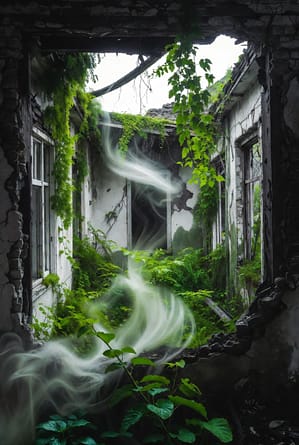 By the time the house in Anytown is condemned, there is nothing left to touch.
The decision arrives quietly, delivered in paperwork and caution tape. Structural failure. Environmental contamination. Decades of treatments layered invisibly into the building—lead paint, asbestos fibers, pressure-treated lumber, chemical sealants whose names no one remembers but whose residues remain.
“Green buildings are designed to reduce the overall impact of the built environment on human health and the natural environment by: efficiently using energy, water, and other resources; protecting occupant health.” — U.S. Environmental Protection Agency.
The house is no longer a site.
It is a hazard.
Entry is prohibited. Salvage is forbidden.
What remains is distance.
Stephen Schappert stands outside, looking in through an opening where a window once was. He does not cross the threshold. He cannot. The dust inside is no longer just gypsum and lime and wood. It is toxic. The house has absorbed the worst habits of every era that passed through it.
“This,” he says, “is what happens when you keep adding without understanding.”
There will be no saving of beams.
No recovered nails.
No material continuity.
The building will be sealed, dismantled under protocol, erased by necessity rather than choice.
And yet, this is not the end of the story.
“Asbestos is a human carcinogen and is one of the most hazardous substances to which humans are exposed in both occupational and non-occupational settings.” — U.S. Environmental Protection Agency
BIOS: life as the measure
BIOS is Greek for life.
The BIOS Philosophy is the study of green, healthy, holistic, organic, sustainable and energy efficient living.
Standing outside a house that can no longer be entered, Stephen insists that the philosophy matters more—not less—when salvage is impossible.
“BIOS isn’t about what you rescue at the end,” he says. “It’s about what you never poison in the first place.”
This house did not fail because it aged. It failed because each generation treated it as temporary. Chemicals were added for convenience. Shortcuts were taken for speed. Materials were layered without regard for interaction or consequence.
What was meant to modernize the home ultimately made it uninhabitable.
Under the BIOS Philosophy, sustainability is not cosmetic. It is cumulative. Every material introduced into a home becomes part of its long-term biology. Every finish participates in the future—either as nourishment or as contamination.
“A building is a body,” Stephen says. “And bodies remember everything.”
“The greatest opportunities to reduce health impacts of use stage exposure to chemicals is at the design phase… Making choices at this stage to use components and materials that do not expose humans to known hazardous substances reduces or eliminates potential exposures.” — Lei Huang, researcher at the University of Michigan
When care is deferred, toxicity accumulates
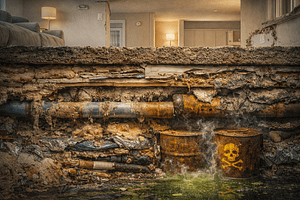 Earlier civilizations built with fewer options, but clearer assumptions. Materials were inert or repairable. Damage could be addressed. Time was allowed to work slowly.
Modern interiors often operate differently. Layers accumulate without removal. Synthetic materials seal in others. Solutions compound instead of resolving. What cannot be seen is ignored.
“We didn’t include the cost of compatibility,” Stephen says. “We just kept adding.”
The result is a paradox: homes designed for comfort that eventually become unfit for life.
This is where the BIOS Philosophy draws its sharpest line. A building that cannot be safely touched cannot be said to support life—no matter how efficient it once was, no matter how beautiful it appeared in its prime.
“We have a moral responsibility to protect the earth and ensure that our children and grandchildren have a healthy and sustainable environment in which to live.” — Jim Clyburn, U.S. Congressman and civil rights leader
The archaeology of prohibition
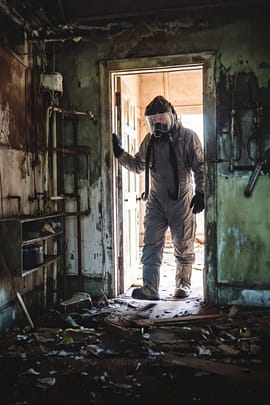
Future archaeologists will encounter structures like this one differently.
They will not excavate interiors carefully. They will approach with caution, aware of contamination. Some sites may remain sealed entirely—zones of exclusion within the record.
The irony will be difficult to miss.
The spaces that mattered most to us—the places where we cooked, slept, raised children—will be inaccessible not because they collapsed, but because they were chemically compromised. The architecture of intimacy will become the archaeology of avoidance.
“Sustainable development is the development that meets the needs of the present without compromising the ability of future generations to meet their own needs.” — Gro Harlem Brundtland, former Prime Minister of Norway and chair of the Brundtland Commission.
This, too, will speak.
It will tell of a civilization that mastered chemistry but failed to account for accumulation. That optimized for short-term performance while externalizing long-term cost. That mistook modernity for safety.
“The poisons are the artifact,” Stephen says. “Not the walls.”
What cannot be salvaged still teaches
There is nothing to take from the house.
No object to carry forward.
No relic to honor.
And yet, the lesson remains intact.
“A healthy home is one that is dry, clean, safe, ventilated, free of pests and contaminants, well maintained, and thermally comfortable.” — National Center for Healthy Housing
The BIOS Philosophy does not ask us to romanticize the past or fetishize old materials. It asks us to recognize that life—human and environmental—is cumulative, fragile, and responsive to care.
A home built according to BIOS would not need to be condemned to be understood. Its materials would not conflict. Its aging would be visible, not dangerous. Its future would be legible.
“This place,” Stephen says, looking at the sealed structure, “is the cost of pretending nothing lasts.”
The final word
The house in Anytown will not be excavated someday. It will be removed carefully, its debris handled as waste, its interior lost without study.
But future archaeologists will still know it existed.
They will know because of the layer it leaves behind.
Because of the chemical signatures it contributes.
Because of the absence it creates.
They will not ask whether we were innovative.
They will not ask whether we were efficient.
They will ask whether we understood that living systems remember.
Whether we built for life.
Whether we practiced BIOS—not as a slogan, but as responsibility.
Whether we intended to stay.
Epilogue: The Architecture of Evidence
The house in Anytown will never be an excavation site. It will be a liquidation.
Under the sterile gaze of regulation, it will be dismantled as a biohazard, its interior erased before it can ever be examined. There will be no patient brushing of dust from artifacts, no careful mapping of domestic life. The rooms where a family once breathed will be reduced to a matter of compliance—a logistics problem solved by a landfill.
And yet, in the cold accounting of deep time, it will remain.
Not as architecture, but as evidence.
“The ultimate test of man’s conscience may be his willingness to sacrifice something today for future generations whose words of thanks will not be heard.” — Gaylord Nelson, founder of Earth Day.
Civilizations are rarely remembered for what they loved most; they are defined by what they could not throw away. We do not leave behind our intentions; we leave behind our consequences.
Future archaeologists will find the story of our era written unevenly in the earth. They will uncover foundations poured with a speed that outpaced our understanding—concrete that forgot how to heal, and plastics that refuse to die. They will trace the chemical signatures that mark where our homes once stood, deciphering a record of why these sanctuaries eventually became zones of exclusion.
“Our era will be marked less by the singular monuments we build than by the sheer material saturation we leave behind… layers rich in complex plastics, industrial composites, and chemical residues that defy traditional decay.” — T.S. Eliot, poet and cultural critic
In the strata of our waste, they may notice something more chilling: the silence.
They will find a profound absence where our interiors should be. They will struggle to read how we actually lived because the meaning of our homes dissolved while the waste of our renovations persisted.
From this, they may infer a civilization that asked its homes to carry immense emotional weight while building them as if they were temporary stage sets. They will see a culture fluent in the language of chemistry and design, yet fundamentally uneasy with the slow, honest accumulation of care.
They will not know our digital debates. They will never see our polished “after” photos. They will read our legacy only through what remained when the image was stripped away.
But even among the technofossils, they may find the anomalies:
-
The beam that was salvaged because it still held strength.
-
The floor that was repaired instead of covered.
-
The structure that was built on the assumption that someone, someday, would come back to claim it.
Those traces will be the only things that matter.
They will suggest that even within a system optimized for erasure, there were those who understood that life is cumulative. They will prove that some of us remembered that poisons added for convenience never truly disappear, and that care deferred is not care avoided—it is care multiplied for the next generation.
BIOS is the Greek word for life. If there is a philosophy to be recovered from our ruins, it won’t be found in our certifications or our slogans. It will be inferred from whether our buildings supported the life within them or slowly undermined it.
Future archaeologists will not ask if we were modern.
They will ask if we ever truly knew how to stay.
And the answer will be written—quietly, unmistakably—in the grace of what we allowed to remain.
“In the epic saga of mankind’s ascent, the BIOS ethos emerges not as mere innovation, but as the vital pulse propelling us toward cosmic harmony: a sacred covenant to weave our dwellings into the fabric of life itself, ensuring that our footprints upon the Earth become bridges to eternity, not chasms of regret.” — Stephen Schappert
