
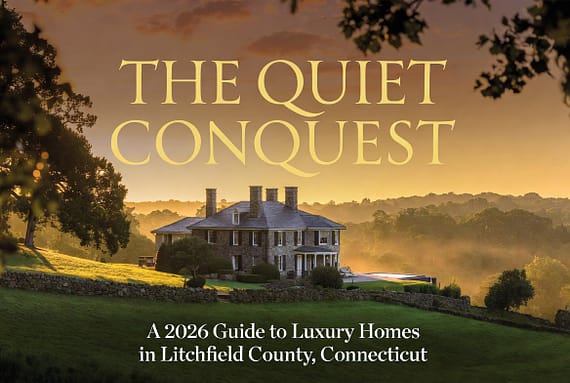
March 4, 2026 — Dawn breaks over the Litchfield Hills like a watercolor left too long in the rain. Mist clings to stone walls built before the Revolution, then lifts to reveal a landscape that has quietly become one of the Northeast’s most coveted addresses for the affluent. Not the flash of the Hamptons or the pedigree of Greenwich, but something rarer: room to breathe, history you can touch, and a two-hour train ride that still gets you to Manhattan for a board meeting.
This is Litchfield County in spring 2026 — where New Yorkers are no longer weekenders but full-time residents, where California refugees from wildfire seasons have planted new roots, and where a $6 million estate with a private dock on Lake Waramaug sells in weeks, not months. Property values here have climbed roughly 30 percent since the pandemic, transactions above $3 million have surged into the dozens annually, and the sweet spot between $1.5 million and $2.5 million for turnkey homes with views and pools has become fiercely competitive.
This is not hype. It is the new reality of “quiet luxury” — the kind that doesn’t announce itself with gates and guards but with 30 acres of conserved land, a restored 1790s farmhouse, and neighbors who include Oscar winners and tennis legends. Welcome to the definitive 2026 guide to buying, owning, and truly living in one of America’s most under-the-radar luxury markets.
From Colonial Outpost to Post-Pandemic Sanctuary
Litchfield County was never meant to be flashy. Founded in the early 1700s, its villages — Litchfield, Kent, Washington, Roxbury, Salisbury, Sharon — grew up around gristmills, iron forges, and the first law school in America (Tapping Reeve’s in Litchfield). The hills supplied cannon for the Revolution and later became summer retreats for Gilded Age industrialists who built “cottages” of 20 rooms or more.
By the late 20th century, the area had settled into genteel semi-obscurity — a place for second homes, horse farms, and the occasional celebrity seeking privacy. Dustin Hoffman and Stephen Sondheim kept residences here; Denis Leary built his own hockey rink; Kevin Bacon and Kyra Sedgwick settled near Lakeville and Sharon; Jane Curtin calls Sharon home. Diane von Furstenberg once owned Cloudwalk farm in the area. Even Ivan Lendl’s 445-acre Cornwall estate set a county record when it sold for $12 million in recent years.
Then came 2020. The pandemic accelerated what had been a slow trickle into a flood. Manhattan apartments felt like cages; Zoom calls from glass towers lost their luster. Suddenly, the same two-hour Metro-North ride to Grand Central that once felt like exile became a lifeline. Elite private schools — Hotchkiss in Lakeville chief among them — became magnets for families fleeing urban density or Western wildfires. Lower taxes, vast acreage, and that indefinable New England calm did the rest.
By early 2026, the transformation is complete. As real estate broker Bill Melnick told CityBiz in February, “New York buyers aren’t just weekending anymore — and it’s reshaping the entire market.” Trophy properties now demand a “completely different playbook,” he says. “You can’t wait for the right buyer to find you.”
The Numbers Behind the Boom
The data tells a story of resilience and refinement. County-wide, the average home value sits at approximately $405,000 (up 3.1 percent year-over-year), but that figure masks the luxury segment entirely. Median listing prices hover around $550,000, while single-family sales averaged $806,000 in February 2026. In the true luxury tier, the story changes.
- The $1.5–$2.5 million range is the most active, driven by buyers seeking move-in-ready homes with sweeping views, infinity pools, and guest houses.
- Sales above $3 million, once exceptional, now number in the dozens annually.
- Overall property values have risen roughly 30 percent since 2020.
- Inventory is finally building in spring 2026, yet demand remains strong — especially from out-of-state buyers who prioritize privacy, schools, and rail access over coastal price tags.
Recent record-setting sales illustrate the shift. In 2025 alone:
- Dragonfly Farm in Kent fetched $6.7 million — the county’s highest residential sale of the year. The historic compound dates to the 1700s, with a Federal-style stone main house expanded by noted architects, plus a guest house, antique barn, caretaker’s cottage, and stone cabana.
- A custom modern estate on Lake Waramaug in Washington sold for $6.4 million: 31 acres, five-bedroom main house, infinity pool, 100 feet of waterfront, and abutting land-trust trails.
- White Tail Farm in Roxbury went for $6.25 million — 86 acres centered on a lovingly restored 1790s farmhouse with pool, tennis court, equestrian facilities, and spring-fed pond.
Current listings (as of March 4, 2026) show no slowdown. Zillow highlights properties topping $8 million: a six-bedroom, eight-bath estate in Salisbury for $8.875 million; an 8,457-square-foot resort-style home with pool in New Milford for $8.2 million; and a nine-bedroom, 12,000-square-foot property in Sharon preserving original details for $7.5 million. These are not McMansions — they are estates where history and modern luxury coexist.
Where to Plant Your Flag: Neighborhood-by-Neighborhood
Litchfield County rewards the discerning. Choose wrong and you trade convenience for isolation; choose right and every season feels like a different painting.
Litchfield Borough — The historic heart. Walkable to the green, dining, and cultural events. Buyers here prize authenticity: classic colonials in the Historic District that have appreciated strongly due to limited supply. Ideal for those who want storybook charm with modern upgrades. Strong 2026 trend: historic integrity paired with contemporary kitchens and smart-home systems.
Washington and Roxbury — For the estate buyer. Rolling acres, stone walls, and privacy. The $6.4 million Lake Waramaug property and $6.25 million White Tail Farm exemplify the appeal: room for horses, pools, guest compounds, and conservation easements that protect views forever.
Kent and Salisbury — The cultural and natural sweet spot. Kent offers the fabled Dragonfly Farm pedigree and proximity to the Appalachian Trail; Salisbury delivers Berkshire vistas and top-tier schools. Waterfront or water-view premiums are real here — scarcity drives prices even inland.
Sharon and Lakeville — Celebrity-adjacent quiet. Kevin Bacon’s neighborhood and Jane Curtin’s hometown. Expansive estates with original details, equestrian potential, and that rare combination of seclusion and sophistication.
New Milford and Warren — Emerging luxury frontiers. Larger modern builds (think the $8.2 million resort-style home with pool) and panoramic hilltop properties appeal to younger affluent families seeking scale without the ultra-traditional vibe.
Across all areas, 2026 buyers prioritize three things: acreage for privacy and outdoor living, water access or views (even a pond adds cachet), and homes that balance historic character with modern utility — geothermal heat, chef kitchens, and spaces for multigenerational or remote-work life.
The Lifestyle Equation
Owning here is not about square footage; it is about how you spend your days.
Mornings might begin with a hike on land-trust trails behind your property. Afternoons could involve kayaking on Bantam Lake or watching your children compete at Hotchkiss. Evenings: dinner at a farm-to-table spot in Litchfield or a private chef on your bluestone terrace. Weekends: Metro-North to the city for a show, back in time for Sunday supper.
Taxes remain comparatively low. Schools are excellent. The pace feels deliberate — 55 days on market average in recent data, a far cry from the frenzy elsewhere. As one broker noted, the “quiet luxury” shift has settled in: buyers now seek solitude, acreage, and timeless New England craftsmanship over flash.
A Buyer’s Practical Guide for Spring 2026
- Timing: Inventory is building — act before Memorial Day if you want choice. Rates have stabilized; the window is open.
- What to inspect: Turnkey vs. project. The $1.5–$2.5 million segment rewards homes with pools and views already in place. Trophy buyers should budget for proactive marketing and multi-market strategy.
- Key features commanding premiums: 20+ acres, guest houses, pools/hot tubs, barns or equestrian facilities, water frontage, preserved views, and proximity to rail or schools.
- Work with specialists: Firms like Elyse Harney Real Estate, William Pitt Sotheby’s, and local experts (Bill Melnick, the Klemm team, Madonna & Phillips) understand the nuanced playbook for out-of-state buyers.
- Due diligence: Check conservation easements (they protect value), flood zones (minimal in hill towns), and septic/well systems common on larger estates.
Looking Ahead
Spring 2026 signals continued strength. California relocations have added a new layer of demand. Elite schools remain a draw. The rail connection to Manhattan keeps the area accessible without the suburban sprawl tax. Most telling: New York buyers are putting down permanent roots — converting weekend compounds into primary residences and legacy properties for their children.
Litchfield County has always been beautiful. What has changed is that beauty is now paired with one of the Northeast’s most compelling value propositions in luxury real estate: space, history, community, and privacy — all at a fraction of coastal or Hamptons prices.
The hills are calling. The question is no longer whether you can afford to answer, but whether you can afford not to.
