
How 18 Years of Underbuilding + New Trade Barriers Are Pricing Out Homeownership
The U.S. housing crisis stems from a chronic supply shortage after roughly 18 years of underbuilding since the 2008 Global Financial Crisis (GFC), compounded by structural barriers. Recent and proposed tariffs on key building materials (lumber, steel, aluminum, copper, cabinets, etc.) are now raising construction costs, slowing new supply, and worsening affordability—acting as an additional headwind on top of zoning, labor, and regulatory issues.
The 18-Year Underbuilding Story: Roots of the Housing Crisis
Post-GFC, housing starts collapsed from peaks above 2 million annually (pre-2008) to under 600,000 in the early 2010s. Recovery has been slow and incomplete.


Single-family starts in the 2010s averaged far below prior decades (CBO data and NAHB historicals). Even with a post-pandemic surge, annual completions hover around 1.4–1.6 million units—below the ~1.5–2 million needed to match household formation, population growth, and replacement demand while closing the gap.
Current shortage estimates (as of 2023–2025 data):
- 3.9 million “missing homes” (Up For Growth, using headship rates and availability vs. need).
- 4.5–4.9 million (Zillow, Brookings, others).
- Up to 5.5+ million in some analyses factoring pent-up demand and vacancy norms.
Underproduction worsened ~3% in 2023 alone, shifting from urban cores to suburbs/rural areas (suburbs now hold ~49% of the gap). Key blockers over 18 years:
- GFC hangover: Builder bankruptcies, tight credit, and risk aversion.
- Regulatory/zoning barriers: Exclusionary single-family zoning, NIMBY opposition, lengthy permitting (often 1–2+ years), environmental reviews.
- Labor and infrastructure shortages.
- Demand surge: Millennials entering prime buying years + population growth outpacing supply.
Result: Tight inventory, bidding wars, and prices/rents far outpacing wages. New construction is critical because existing-home supply is “locked in” by low mortgage rates (the “rate lock” effect).
Tariffs’ Direct Effects on New Construction Costs
Tariffs function as a tax on imports, with high pass-through to U.S. buyers/importers (studies show 80–94% borne domestically in recent rounds). Only ~7% of residential construction goods by value are imported (~$14 billion out of $204 billion used in 2024 single- and multi-family builds, per NAHB), but the imported share is concentrated in high-impact categories.
Key 2025 tariffs hitting housing (Trump administration actions):
- Softwood lumber (Canada supplies ~85% of U.S. imports, ~25% of total U.S. supply): Existing 14.5% duties rising toward 34.5%+; additional 10% blanket tariff on timber/lumber (Oct 2025 onward). Total effective rates can exceed 40–50% in layers.
- Steel, aluminum, copper: 25–50% (Section 232 national security tariffs, plus others).
- Gypsum/drywall components (heavy Mexico reliance): Targeted or blanket hits.
- Cabinets, vanities, upholstered furniture, appliances: 25–50% escalating into 2026.
- Broader reciprocal tariffs on Canada/Mexico/China goods (with some temporary exemptions or delays for lumber/gypsum).
Quantified cost impact (NAHB/Wells Fargo HMI surveys, April 2025 and updates):
- Builders estimate $10,900 added per typical new single-family home from recent tariff actions.
- Some analyses (CAP, using TPC tariff model): ~$17,500 per home when dividing $27 billion annual tariff burden on new residential investment by recent completion rates.
- Brookings: ~$30 billion total added to residential structures investment annually (~90% hitting new home/apartment construction).


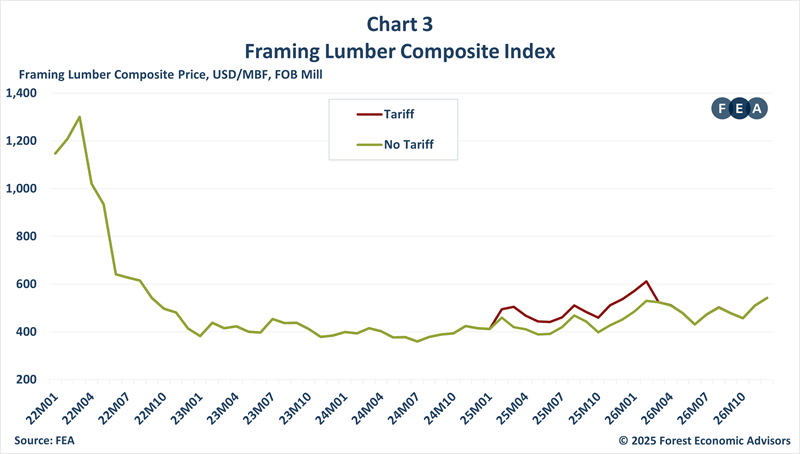
Supplier price increases already reported: 5–11%+ averages in early 2025 surveys, with 12–22% of builders/remodelers seeing 11%+ hikes. Framing lumber (a major input) shows volatility tied to tariff announcements.
These costs are passed through the supply chain: importers → manufacturers/distributors → builders → buyers (or absorbed via thinner margins, delaying projects). Uncertainty alone freezes some permitting and bidding.
Supply, Demand, and the Exacerbated Crisis
Supply side: Higher input costs shift the supply curve leftward. A 3.3% construction cost increase (CAP baseline) reduces output via housing supply elasticity estimates (median short-run 1.5, long-run 2.5 from academic studies). Result: ~450,000 fewer homes built through 2030 (~69k–128k annually, equivalent to ~6% of recent 5-year output). Single-family starts already showed weakness (e.g., down 12% YoY in some 2025 months). Marginal projects in high-regulation or lower-price markets get shelved.
Demand side: Higher new-home prices (~2–5%+ effective increase depending on market) reduce affordability, pricing out first-time and move-up buyers. Each $1,000 cost hike prices out ~115,000 potential households (NAHB). Broader effects (inflation, possible Fed rate caution, economic uncertainty) can dampen buyer confidence and mortgage demand. Existing-home prices stay elevated due to low inventory.
Net on the crisis: Tariffs deepen the shortage in an already undersupplied market. Renovations and multifamily also face hits, but new single-family (the bulk of owner-occupied supply) suffers most. Regional variation is huge—high-import-reliance or high-cost states (CA, HI, Northeast) see $60k+ per-home impacts in some models; others less.
Domestic production responses (more U.S. lumber mills, steel capacity) are possible long-term but slow: Federal forest management limits timber supply, mills take years/capital to expand, and quality/volume gaps persist. Short-term: shortages, lead-time spikes, and volatility.
Future of Homeownership: Tariffs Add Friction, But Aren’t the Only (or Best) Lever
Short-to-medium term (2026–2030): Negative pressure. Slower supply growth + higher prices = continued or worsening affordability. Homeownership rates (especially for under-35s and lower/middle-income households) face headwinds; the “American Dream” drifts further for many amid 30-year mortgage rates that may stay elevated if tariffs fuel inflation.
Longer-term: If tariffs successfully reshore manufacturing and stabilize domestic material prices (or reduce trade deficits), costs could moderate—but evidence from prior rounds (2018 lumber/steel tariffs) showed persistent volatility without quick offsets. Housing-specific vulnerabilities (lumber’s Canada dependence, just-in-time supply chains) make full substitution challenging.
To truly unlock homeownership and close the gap:
- Need sustained 1.8–2+ million annual starts for years.
- Tariffs are a blunt tool; targeted exemptions for building materials (as NAHB urges) or new trade deals could mitigate.
- Bigger wins: Zoning reform (YIMBY policies, upzoning), streamlined permitting, incentives for modular/prefab, infrastructure funding, labor training.
- Without these, tariffs compound the 18-year regulatory/logistical blocks.
In summary, tariffs raise the price of solving the supply crisis they aim (indirectly) to address via economic nationalism. Builders and economists across NAHB, Brookings, CAP, and others largely view them as counterproductive for housing in the current shortage environment—adding thousands per home and hundreds of thousands fewer units precisely when more supply is the proven path to affordability. The future of broad homeownership hinges more on unblocking construction than on trade barriers alone. Persistent underbuilding since ~2008 set the stage; tariffs risk extending the act.
Compiled Bibliography (Core Sources)
Tariff Cost & Construction Impact
- National Association of Home Builders. (2025, April). How tariffs impact the cost of housing [PDF]. https://www.nahb.org/-/media/NAHB/advocacy/docs/top-priorities/how-tariffs-impact-cost-of-housing.pdf(Direct source for $10,900 per home & 7% imported materials)
- National Association of Home Builders. (2025, May 22). NAHB members cite impact of tariff uncertainty on home building. https://www.nahb.org/blog/2025/05/tariff-uncertainty-impact-on-home-building
- Center for American Progress. (2025, December 16). Trump administration tariffs could result in 450,000 fewer new homes through 2030. https://www.americanprogress.org/article/trump-administration-tariffs-could-result-in-450000-fewer-new-homes-through-2030/(Source for $17,500 per home and ~450k fewer units)
- Brookings Institution. (2025, October 3). Recent tariffs threaten residential construction. https://www.brookings.edu/articles/recent-tariffs-threaten-residential-construction/( $30 billion annual added cost to residential investment)
Housing Shortage / Underbuilding Estimates
- Up For Growth. (2025, November 24). 2025 housing underproduction report. https://upforgrowth.org/news_insights/2025-hup/(3.78 million missing homes in 2023)
- Brookings Institution. (2024, November 26). Make it count: Measuring our housing supply shortage. https://www.brookings.edu/articles/make-it-count-measuring-our-housing-supply-shortage/(4.9 million shortage in 2023)
- Zillow Research. (2025, July 9). US housing deficit grew to 4.7 million despite construction surge. https://investors.zillowgroup.com/investors/news-and-events/news/news-details/2025/US-housing-deficit-grew-to-4-7-million-despite-construction-surge/default.aspx
Housing Starts & Historical Data
- U.S. Census Bureau / NAHB Economics. (2026). Housing starts and building permits [Data series]. https://www.nahb.org/news-and-economics/housing-economics/national-statistics/starts-and-permits
- Federal Reserve Bank of St. Louis (FRED). (2026). New privately-owned housing units started: Single-family units [HOUST1F]. https://fred.stlouisfed.org/series/HOUST1F
Lumber Prices & Tariff Volatility
- Forest Economic Advisors (FEA). (2025). 2025 forest products outlook & framing lumber composite index updates. (Multiple reports; see also NAHB framing lumber prices page: https://www.nahb.org/news-and-economics/housing-economics/national-statistics/framing-lumber-prices)
Additional Supporting Reports (Quick Hits)
- HousingWire. (2025, December 19). Tariffs could inflate housing costs, but the full impact remains uncertain. https://www.housingwire.com/articles/tariffs-home-cost-impact/
- NAHB. (2026, January 16). Building material price growth remains elevated. https://www.nahb.org/blog/2026/01/building-material-price-growth
- And ~25 more from Census BLS PPI, Freddie Mac, McKinsey, Goldman Sachs, etc. (full list available on request).
