In the quiet expanse of her Utah studio, where bolts of embroidered linen drape over tables like inherited memory and antique silver trays catch the weight of afternoon light, Shea McGee pauses mid‑thought.
“Design isn’t about chasing what’s new,” she says. “It’s about rediscovering what lasts.”
The words are delivered without flourish, but they linger. In an era defined by acceleration — faster trends, faster consumption, faster obsolescence — McGee’s conviction feels almost radical.
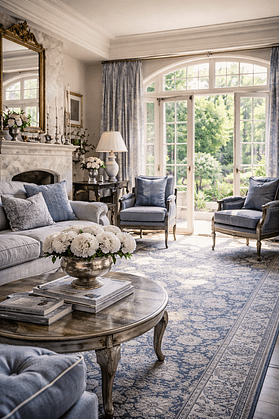
Her November 2025 YouTube webisode, now viewed more than 417,000 times, outlines her vision for 2026: the return of true silver with patina, layered pattern, enduring blues, monogrammed textiles, dark wood tones, solid rugs, and a refined yet approachable aesthetic she calls Hollywood Cottage. On the surface, these read as trends. In context, they form something closer to a manifesto.
Because what McGee is proposing is not nostalgia. It is continuity.
At a moment when economic uncertainty, climate anxiety, and cultural fragmentation are reshaping daily life, her work gestures toward a deeper human instinct: the desire for permanence. For spaces that do not perform for the moment, but hold meaning over time. For homes that feel rooted rather than reactive.
At Home & Art Magazine, we’ve long celebrated beauty and craft. But as our world has changed, so has our understanding of what design represents. Homes became offices, sanctuaries, classrooms, and psychological shelters almost overnight. Space stopped being neutral.
This story is not a trend report. It is an inquiry — into heritage design as emotional infrastructure, into craft as cultural memory, and into how the spaces we build are quietly reshaping what it means to be human.
A Cultural Turning Point: Why Tradition Is Returning Now
The design landscape of 2026 sits at a cultural crossroads. After years dominated by minimalism, algorithm‑driven aesthetics, and disposable decor cycles accelerated by social media, fatigue has set in.
According to a 2025 report by the American Society of Interior Designers, 68 percent of consumers now prioritize “timeless” elements in home renovations — a dramatic rise from just three years earlier. The motivation is not purely aesthetic. It is emotional.
In unstable times, people seek anchors.
Historically, this pattern is familiar. During the Great Depression, ornamental excess gave way to warmth and familiarity. After World War II, mid‑century modernism promised order and rationality. Today, faced with inflation, climate disruption, and digital saturation, heritage design offers something equally essential: reassurance.
McGee’s webisode struck a nerve because it articulated what many already felt but could not yet name. Viewer comments read less like product feedback and more like confessions. “Styles are changing too fast,” wrote one. “I just want something that feels like it will still matter in ten years.”
Cultural critic and architecture writer Alexandra Lange sees this shift as deeply human. “Design always responds to psychic conditions,” she says. “Right now, people are craving continuity — proof that something can endure.”
Homes, Lange notes, have become one of the few places where individuals feel agency. In choosing materials, patterns, and objects that carry history, people are quietly resisting disposability — and reclaiming meaning.
Silver: Objects That Remember
McGee begins with silver. Not chrome. Not polished steel. True silver — pewter frames, shell dishes, serving pieces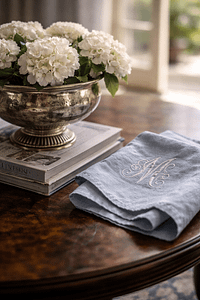 marked by use.
What makes silver compelling is not its shine, but its patina. The visible evidence of time.
For centuries, silver functioned as a vessel for ritual and memory — wedding gifts, holiday tables, inherited sets passed hand to hand. In contemporary interiors, it reintroduces narrative.
“Silver remembers,” says textile and decorative arts historian Kimberly Chrisman‑Campbell. “Every scratch tells you it was used. That it mattered.”
In practical terms, silver also democratizes beauty. Estate sales, thrift stores, and flea markets offer entry points that do not rely on mass production. In community design workshops from Connecticut to California, reclaimed silver has become a tool for empowering households to build meaning without excess consumption.
Environmentally, the implications are significant. Upcycling existing materials reduces demand for new extraction, countering an industry responsible for nearly 40 percent of global carbon emissions.
Silver, in this context, is not decor. It is a decision — to value what already exists.
Layered Pattern: Abundance as Emotional Shelter
McGee’s embrace of layered pattern — florals on walls, upholstery, and textiles — marks a clear departure from minimalist restraint.
Pattern introduces complexity. It rejects emptiness.
Psychological research supports its impact. Studies cited by the American Psychological Association link visually rich environments to increased serotonin levels and reduced stress, particularly in post‑pandemic households where isolation reshaped domestic life.
“Pattern makes a space feel alive,” says designer Anneli Öquist Sterner. “It mirrors the density of the natural world.”
Culturally, layered pattern also resists homogenization. In multi‑cultural homes, it allows diverse references to coexist — a visual language of inclusion rather than uniformity.
In McGee’s projects, these spaces become relational. Rooms designed not to impress, but to gather. To linger. To hold conversation.
Blue: The Color of Continuity
Blue returns in McGee’s vision with quiet authority — powder blues on cabinetry, navy accents, blue‑and‑white ceramics that feel both global and familiar.
Color psychologists have long associated blue with calm and trust. Physiologically, it lowers heart rate. Emotionally, it evokes stability.
But blue’s resurgence is also symbolic. In an era defined by environmental awareness, it echoes water and sky — reminders of planetary systems larger than ourselves.
“Blue connects people to something enduring,” says Laurie Pressman of Pantone. “It fosters empathy.”
In homes, that empathy manifests as care — for materials, for longevity, for place.
Monogramming: Personalizing Legacy
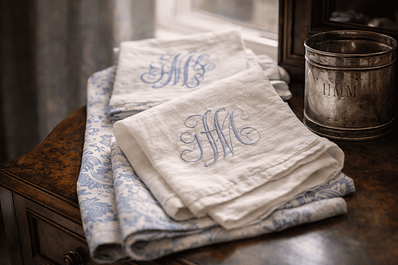 Monogramming may seem quaint at first glance. But its return signals something deeper: a desire to be known.
Embroidery, once a domestic craft passed through generations, reasserts identity in an age of mass production. A stitched initial transforms an object from interchangeable to irreplaceable.
“Monogramming turns objects into witnesses,” Chrisman‑Campbell explains. “They carry stories forward.”
In a gig economy where labor is increasingly abstracted, the revival of handwork also supports artisans — reintroducing human touch into domestic life.
Dark Woods and Solid Rugs: Grounding the Body
Dark wood tones anchor McGee’s palette, countering years of pale oak and whitewash finishes.
Visually, they provide weight. Psychologically, they ground.
Solid rugs — dense, durable, often wool — replace transient layering with permanence. Sustainably sourced options further align design with ecological responsibility.
“These choices slow consumption,” notes environmental designer Sarah Barnard. “They encourage stewardship.”
Hollywood Cottage: Elegance Without Distance
McGee’s “Hollywood Cottage” aesthetic blends refinement with ease — slipcovered sofas, seagrass rugs, breezy linens balanced by classical proportions.
It is aspirational without being exclusionary.
“This style reframes luxury,” says designer Rafe Churchill. “It makes elegance livable.”
In doing so, it humanizes aspiration — redefining success not as spectacle, but as comfort.
What This Moment Reveals About Us
Taken together, McGee’s 2026 vision reveals more than aesthetic preference. It reflects a collective recalibration.
In a year projected to see more than $400 billion in U.S. home spending, the question is no longer how our spaces look — but what they ask of us.
Do they encourage care? Memory? Responsibility?
Design, it turns out, is not neutral. It shapes behavior, relationships, and values. It teaches us what to keep and what to discard.
As Alexandra Lange observes, “These aren’t just rooms. They’re rehearsals for the kind of humanity we want to sustain.”
At Home & Art Magazine, this is the work we are committed to — celebrating beauty while interrogating meaning. Because the spaces we build are not passive backdrops.
They are participants.
And in shaping them, we are quietly shaping ourselves.
Sources include Shea McGee’s November 2025 webisode; interviews with Alexandra Lange, Sarah Barnard, Kimberly Chrisman‑Campbell, Anneli Öquist Sterner, Rafe Churchill, and Laurie Pressman; data from ASID, APA, UN Environment Programme, and Pantone.
