
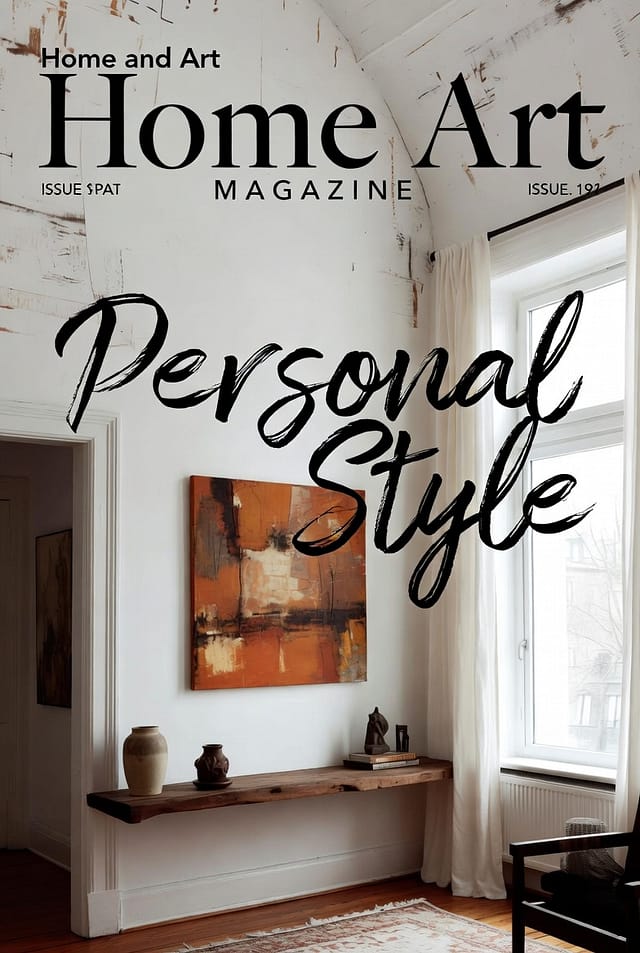
Personal Style: How Identity Shapes Space
Personal style is not decoration. It is the architecture of self — the evidence of interior life made visible in material choices, spatial gestures, and the curated presence of meaning.
Style as Evidence of Being
When we walk into someone’s home, it becomes clear that personal style is more than color palettes and objects. The arrangement of furniture, the books that line shelves, the objects kept on mantels, the textiles selected for comfort — all are evidence of priority and habit.
A carefully chosen object is not only beautiful; it is **meaningful**. A second-hand chair chosen for comfort and memory carries a different narrative than a mass-produced piece selected for trend alone. Personal style is the sum of choices that shape how space is inhabited, over time.
Style, in this deeper sense, is not about *performance* — it is about *life*. It is the record of how someone *actually* lives, not how they wish to be perceived.
Material Signals of Identity
The materials people choose — wood grain, textiles, metals, ceramic surfaces, stone — are not neutral. They carry signals about cultural reference, tactile preference, memory, and comfort. Materials are vocabulary; the home is a language.
An object selected for texture rather than trend reveals a sensitivity to sensation. A textile chosen for warmth reveals care for experience. A ceramic piece passed down through generations holds lineage. These choices are material evidence of identity.
Personal style grounded in material intelligence gives space *gravity* — a sense that the environment responds to life, not the other way around.
Memory and the Curated Archive
Personal style is inseparable from memory. A photograph on a shelf, a vintage vase gifted by a parent, a textile acquired in another city — all of these are residues of lived experience. A home becomes a curated archive of memory, not an Instagram set.
Memory distinguishes personal style from aesthetic branding. A wall covered in souvenirs from travel, or a shelf that holds collected letters and books, is not a “look” — it is a life lived. These objects anchor experience in space.
In this sense, personal style is *psychological geography* — the way interior spaces map inner life.
Style, Habit, and Routine
Personal style is also about habit. Where someone places their coffee cup each morning. How they prefer to encounter light in the evening. Which chair becomes the default seat for reading or conversation. These repeated patterns give shape to interior space.
Habit is quiet but powerful evidence. It determines wear patterns, circulation paths, and the places people return to again and again. A room may be spectacular in photography, but it gains depth when it *functions* as lived life.
Personal style that accommodates habit respects the rhythms of life rather than imposing arbitrary staging.
Cultural Identity and Personal Style
Personal style is shaped not only by individual preference but by cultural background. Cultural traditions infuse spatial practice with meaning: how communal meals are arranged, how thresholds are defined, how light and ritual interact.
A room in one cultural context may emphasize communal gathering; in another, niches for contemplation. A collection of craft objects from a specific heritage signals belonging. These decisions are not superficial. They are expressions of values, lineage, and identity.
Recognizing cultural context — rather than erasing it in pursuit of a homogenized “style” — allows personal style to become a *map of belonging*.
Aging, Texture, and Temporal Style
Personal style changes over time because people change. A home that once prioritized utility may evolve to prioritize calm. A space that once reflected youth may learn restraint.
Materials age. Leather patinates. Wood warms. Textiles soften. These transformations are part of personal style — the trace of time on matter. A vintage textile that bears slight fade or a table with worn edges are records of life lived.
An interior that honors these traces — rather than erasing them for uniformity — holds more meaning and emotional depth.
Style Beyond Commodity Culture
In contemporary consumer culture, style is often marketed as a commodity — something purchased, curated for attention, and quickly discarded. But personal style, in its deepest form, resists this cycle. It is not ephemeral. It is cumulative.
Personal style rooted in lived experience does not start with trend boards or shopping lists. It starts with observation of how space supports life and how objects carry memory and meaning. It resists the aesthetics of disposability and embraces the aesthetics of continuity.
This is why homes shaped by personal style often feel *ineffably coherent* — not because they match trend parameters, but because they are grounded in a lifetime of choices, adaptations, and memories.
Objects as Testimony
Every object in a personally styled interior is testimony — not only to taste but to encounter. A stack of books reveals curiosity. A pottery bowl holds ritual of daily use. A well-worn seat bears the imprint of habit.
These elements are not accident. They are decisions. They express how a person or family *makes space livable* — often outside the metrics of style magazines, but deeply within the metrics of life.
Personal style that emerges from this perspective is enduring because it is true to life, not to promotion.
Style and Social Life
Personal style also shapes, and is shaped by, social life. How people arrange spaces for visitors, how seating is oriented for conversation, how zones of gathering invite interaction — these are decisions that mediate social connection.
A home that welcomes lingering conversation or collective meals reveals different social values than one that prioritizes isolated viewing or consumption. These spatial signals are part of personal style: how a household *anticipates* life with others.
Personal style is relational — it communicates not only who someone is, but how they invite others into their space.
Final Questions for Personal Style
If interior space is a record of life, then personal style is its handwriting: legible, layered, and meaning-laden. What does a room say about its inhabitant’s values? What stories do objects carry? Whose history is preserved in shelves, textiles, and thresholds?
These questions are not whimsical. They are cultural. They reveal how personal identity becomes spatial — how people make meaning in environments, and how those environments, in turn, shape memory.
