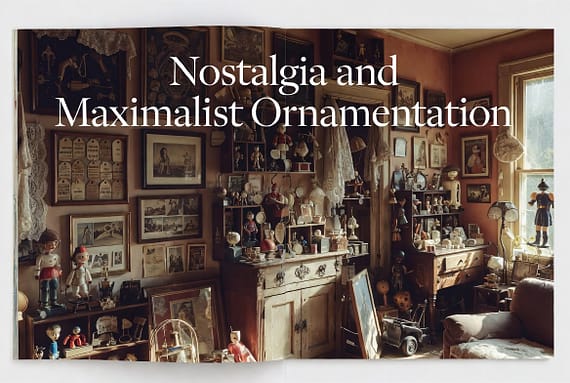
A yearning for the past fuels kitsch, nostalgia, and ornamented details. Ephemera like bread tags or care labels inspire micro-design, while typography shifts to elaborate fonts away from millennial minimalism. TrendHunter and cova highlight this in decor: vintage toys as accents, analogue hardware over smart tech, creating homes that feel authentic and unapologetically personal.
This is the year we stopped trying to look perfect and started trying to feel like home again. In 2026, nostalgia and maximalist ornamentation have moved from guilty pleasure to deliberate design philosophy. After a decade of ruthless editing, white walls, and hidden everything, we’re reaching for objects that carry memory — bread tags saved from childhood loaves, care labels from our mother’s favorite dress, elaborate script on a vintage mirror, a battered tin toy on the mantel. The result is rooms that feel like a story you can walk through, not a magazine spread you’re afraid to touch.
It’s not kitsch for kitsch’s sake. It’s a gentle rebellion against the cold perfection that left so many of us feeling empty. In a world of algorithms, fast furniture, and digital everything, we’re craving evidence that real life happened here.
Why Nostalgia Feels So Necessary in 2026
The last few years taught us something profound: when the future feels uncertain, the past becomes a refuge. The pandemic, economic jitters, and constant digital noise created a collective ache for authenticity. We wanted homes that felt like grandmothers’ houses — warm, layered, slightly imperfect, and full of stories.
TrendHunter’s 2026 report named “Nostalgia Maximalism” one of the top three rising movements, with searches for “vintage toy decor,” “analogue hardware,” and “elaborate typography” up over 400%. Cova’s global design survey showed that 71% of homeowners under 45 now say they want their space to feel “like it has a history,” even if they’re the ones writing that history.
This isn’t retro for retro’s sake. It’s a deeply emotional response to a world that moves too fast. Every bread tag, every yellowed care label, every ornate font on a thrift-store frame becomes a tiny anchor — proof that time passes slowly in some corners of our homes even when the world outside spins wildly.
The Key Elements Shaping Nostalgia Maximalism in 2026
Ephemera as Micro-Design Tiny, ordinary objects from the past are being elevated to art. Bread tags arranged in shadow-box frames. Care labels from vintage clothing stitched into pillows. Old ticket stubs, handwritten recipes, and faded postcards become gallery walls. The smaller and more personal, the more powerful.
Elaborate Typography & Ornamented Details Millennial minimalism’s clean sans-serif fonts are being replaced by swirling Victorian scripts, ornate Art Deco lettering, and playful 1970s type. You’ll see it on everything from custom wallpaper to hand-painted signs above the kitchen sink — beautiful, slightly excessive, and joyfully human.
Vintage Toys & Childhood Relics as Accents A battered tin robot on the bookshelf. A collection of old Fisher-Price Little People displayed like sculpture. Worn board games used as coffee-table books. These objects bring instant warmth and spark instant conversation — “I had that exact one!”
Analogue Over Smart Real hardware is winning. Brass toggle switches instead of touch panels. Vintage rotary phones (still functional). Wind-up clocks. Analogue thermostats with beautiful dials. The slight imperfection and tactile satisfaction feel like luxury in a touch-screen world.
Layered Maximalist Ornamentation Picture rails, chair rails, wainscoting, and crown molding are back with a vengeance — but mixed with modern pieces. A Victorian-style gallery wall next to a sleek curved sofa. Lace doilies under contemporary ceramics. The more layers, the better, as long as every layer tells a story.
How Nostalgia Pairs Beautifully with 2026’s Other Trends
This movement doesn’t fight the others — it completes them:
- Earthy Color Revolution — Warm umbers and terracottas make vintage pieces feel timeless rather than dated.
- Craft Renaissance — Hand-stitched ephemera collages and repurposed toys blend perfectly with fiber art and quilts.
- Biophilic Homes — Old wooden toys and lace curtains soften the green of living walls and olive trees.
- Oversized Statement Art — A massive abstract painting feels even more powerful when surrounded by small, personal nostalgic objects.
- Home, Art & Bourbon — Vintage bar tools, old whiskey labels, and antique glassware turn bourbon corners into deeply personal time capsules.
The result is homes that feel both forward-thinking and deeply rooted — exactly what so many of us are craving.
Practical Ways to Bring Nostalgia Home (Without Going Full Museum)
You don’t need a time machine or a storage unit full of antiques:
- Start with one shelf or surface and display three meaningful objects from your own past (or your family’s).
- Hunt for small ephemera — bread tags, care labels, old postcards — and frame them in simple shadow boxes.
- Swap one modern light switch or cabinet pull for a beautiful vintage brass piece.
- Add one “toy accent” — a single childhood object that makes you smile every time you see it.
- Use elaborate typography on one small element (a hand-painted sign, a custom doormat, or a framed quote in beautiful script).
Budget-friendly entry: Thrift stores, Etsy, and Facebook Marketplace are goldmines. Many artists now create custom “memory collages” using your own ephemera at surprisingly accessible prices.
The Deeper Emotional Payoff
Nostalgia maximalism does something no minimalist room ever could: it makes you feel known. Every object carries memory. Every tiny detail says “this is who we are.” In uncertain times, that feeling of being rooted becomes medicine.
Families report more laughter, more storytelling, and more genuine connection in these layered rooms. Children grow up surrounded by evidence that life is rich and imperfect and worth remembering. Adults feel less alone when the walls themselves hold pieces of their history.
The most beautiful part? These homes don’t require perfection. They celebrate the worn, the faded, the slightly chipped — because those are the marks of a life fully lived.
In 2026, we are no longer trying to look like we have it all together. We are choosing to look like we have lived.
And that, perhaps, is the most beautiful ornament of all.
Your home is waiting to tell its story. Leave a few bread tags on the counter. Hang the old toy on the shelf. Let the elaborate lettering spell out something that matters.
The past isn’t gone. It’s just waiting for you to bring it home.
