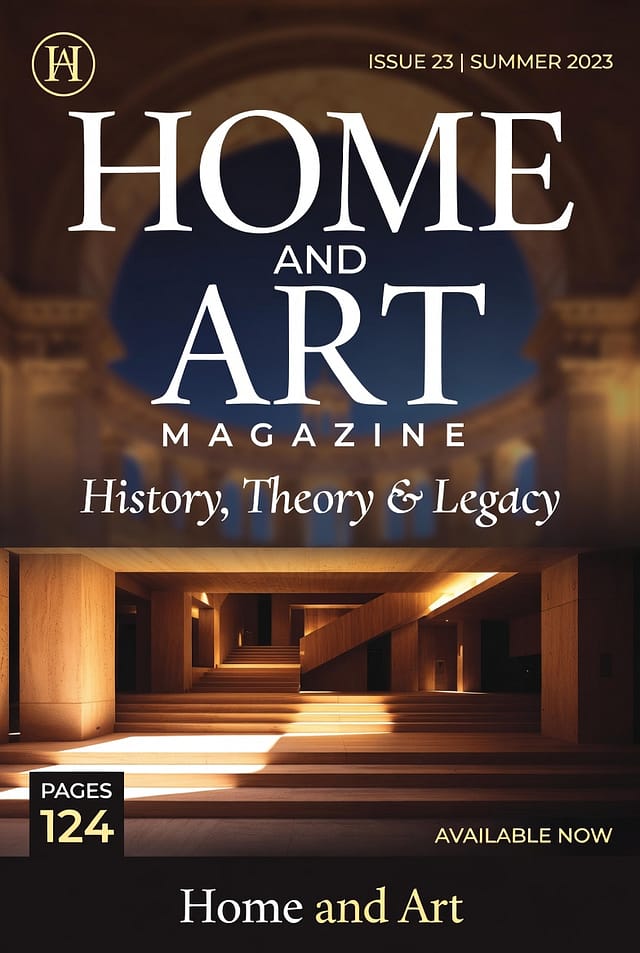
History, Theory, Legacy: Architecture as the Most Human Form of News
Architecture answers how we live together. Art answers why it feels the way it does. Put them together and you are no longer documenting trends—you are recording how humanity understands itself at a given moment.
It accumulates. It remembers. It disciplines and liberates. It holds the story of a society long after the society’s arguments have turned to dust.
That is why Home & Art approaches architecture and art not as lifestyle categories, but as a form of public record—an evidence trail that survives politics,
outlasts technology, and often outlives the words we use to justify our choices.This is also why our ambition is unapologetically high. The purpose of the Pulitzer tradition is not celebrity; it is standards—an institutional insistence that
reporting and writing can serve the public by clarifying reality, revealing power, and creating work that endures beyond the cycle that produced it.
The Pulitzer Prizes were established to honor excellence in journalism and the arts, and they continue to represent a benchmark for public-minded craft and consequence
(Pulitzer history,
Pulitzer.org).We do not write to “win” anything. We write to be worthy of that standard—each story, each time. Not speed-first coverage of what just happened, but work that gathers
facts carefully, interprets them honestly, and places them into a frame that readers can return to years from now and still find true.
Why Architecture Belongs in the Same Room as Journalism
Architecture is a social contract made visible. Every wall draws a boundary. Every street makes a decision about access. Every material carries an environmental cost.
Every housing policy becomes a lived geometry. When we say we cover “homes,” we mean the entire system that produces them: labor, extraction, zoning, finance, climate,
culture, and care. When we say we cover “design,” we mean the ethics of what gets optimized—and what gets sacrificed.
If journalism is the practice of describing the world as it is (and how it is changing), then architecture belongs at the center of that practice. The built world is where
the abstract becomes immediate: inequality becomes distance; “community” becomes a sidewalk or a barrier; climate becomes heat, flood, smoke, and insulation;
technology becomes surveillance, access, or isolation.
In other words: architecture is not the backdrop to history. It is one of history’s primary instruments.
Theory Is Not Decoration—It’s the Tool That Keeps Us Honest
“Theory” can sound academic, but its real function is simple: it helps us avoid mistaking style for truth. Without theory, the modern becomes automatically “better,” the expensive
becomes automatically “important,” and the visually striking becomes automatically “right.” Theory is how we keep the conversation accountable to human experience,
not just visual appetite.
We borrow from thinkers who treated space as a force that shapes inner life and social life—writers like Gaston Bachelard, who explored how rooms and corners become
emotional architecture (The Poetics of Space),
and Jane Jacobs, who argued that streets and sidewalks are not neutral, but civic organs that determine whether a city can be safe, alive, and shared
(Jane Jacobs).
We also look back to the oldest architectural questions—how beauty, durability, and usefulness can coexist—often traced to Vitruvius
(Vitruvius).
Theory, for us, is not a posture. It is a discipline. It gives language to what readers already feel: that spaces can heal or harm, include or exclude,
amplify dignity or erode it slowly. When we publish, we are not merely sharing images. We are publishing an argument about what those images mean in the world.
Legacy: A Mirror Polished by Deep Time
Most editorial work is trapped in the present tense. We choose a different clock. When we examine “trends,” we read them through a mirror shaped by deep time—ten to twenty thousand years
of human making. That timescale changes the questions. It lowers the temperature. It makes the work calmer, stricter, and more responsible.
Deep time reminds us that “home” is one of humanity’s oldest technologies—and that art arrives almost immediately once shelter becomes stable enough to pause inside it.
It reminds us that the domestic sphere is not trivial; it is where people reproduce culture, transmit values, recover from work, and learn what safety feels like.
It reminds us that materials outlive intentions, and that the archaeological record is often built from what we treated as disposable.
Legacy also changes how we measure “importance.” A single room can be more historically revealing than a press conference, because it shows what a society normalized.
What does it mean when a home is designed around screens? When a neighborhood is designed around cars? When climate risk is treated as aesthetic inconvenience instead of structural reality?
When security becomes a market feature? When public space becomes rare?
These are not niche design questions. They are civilizational questions—asked quietly, room by room.
Our Standard: Pulitzer-Level Clarity, Without Pretending to Be the News Cycle
The Pulitzer benchmark matters because it represents a public promise: that journalism can be both readable and rigorous, both beautiful and consequential.
That is the craft we pursue—clear sentences, deep reporting, careful editing, and visual storytelling that does not replace thinking, but strengthens it.
We are not “breaking news.” We are sense-making. We gather data, trace patterns, verify claims, and connect design decisions to their real-world outcomes.
Our stories are written to be understood by anyone online—because accessibility is not a compromise; it is a commitment.
If a story cannot answer the question below, it does not belong here:
What does this space reveal about how we are learning to live now—and who we are becoming?
That question is our editorial compass. It keeps us from drifting into pure aspiration. It keeps us from confusing consumption with culture.
And it keeps us honest about power—because space is power, and “home” is where power becomes intimate.
A Living Record, Built to Endure
Home & Art is building a publication that treats lifestyle as a lens, not an escape. We believe the built world is one of the most truthful archives we have—and one of the most
urgent to interpret, because it is being redesigned in real time by climate pressure, digital life, and widening inequality.
Over time, we will expand the mediums we use to tell these stories—photography, illustration, long-form criticism, and immersive formats that allow readers to inhabit space more fully.
But the mission does not change: to record the built world with depth, clarity, and moral seriousness; to make meaning visible; and to publish work that can be read years from now
and still feel necessary.
If architecture answers how we live together, and art answers why it feels the way it does, then Home & Art exists to hold both truths in the same frame—and to leave behind a record
worthy of what future readers will want to understand.
