
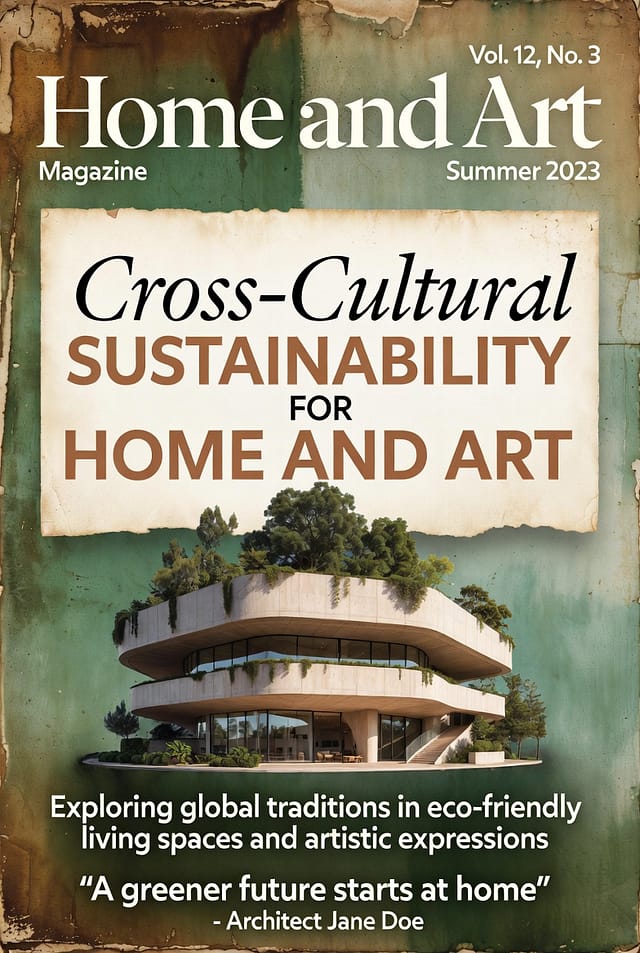
Home and Art Magazine: Cross-Cultural Sustainability
Sustainability is often discussed in terms of technology, materials, and carbon footprints, but its deepest roots are cultural. Across the world, communities have been practicing sustainable living for centuries—long before the term became a global buzzword. Cross-cultural sustainability invites us to look beyond trends and toward traditions, blending ancestral wisdom with modern innovation to shape homes, cities, and lifestyles that honor both people and planet.
In architecture and design, this approach is especially powerful. Consider how different cultures have historically adapted to their environments. In the Middle East and North Africa, thick earthen walls and interior courtyards moderate heat naturally, reducing the need for mechanical cooling. In Japan, traditional homes emphasize natural ventilation, modular spaces, and a close relationship with gardens and outdoor light. In Scandinavia, compact layouts, thermal efficiency, and an appreciation for daylight reflect a deep respect for limited resources and harsh climates. These are not just aesthetic choices—they are cultural responses to place, climate, and community.
Today’s sustainable design movement increasingly draws from these traditions. Architects and designers around the world are rediscovering vernacular building methods—such as adobe construction, bamboo frameworks, rammed earth, and stone masonry—not as nostalgic gestures, but as practical, low-impact solutions. When paired with modern engineering, renewable energy systems, and contemporary comfort standards, these techniques offer a compelling path toward resilient, low-carbon living.
Cross-cultural sustainability is not only about materials and buildings; it is also about values. Many cultures prioritize repair over replacement, sharing over ownership, and longevity over convenience. In parts of Europe and Asia, for example, furniture and household objects are often passed down through generations or restored rather than discarded. In Indigenous cultures worldwide, the idea of stewardship—caring for land and resources for future generations—is central to daily life. These perspectives challenge the disposable mindset that dominates much of modern consumer culture and encourage a more thoughtful, enduring relationship with our homes and belongings.
In interior design, this global dialogue is producing spaces that are both beautiful and meaningful. A home might combine Scandinavian minimalism with African handcrafted textiles, Japanese joinery with Mediterranean ceramics, or Latin American color palettes with modern eco-friendly materials. When done with respect and understanding, this fusion celebrates craftsmanship, supports local artisans, and reduces reliance on mass-produced, short-lived goods. Sustainability, in this sense, becomes as much about cultural continuity as environmental responsibility.
Food, gardens, and domestic rituals also play a role in cross-cultural sustainability. Many traditional cuisines are rooted in seasonal, local ingredients and low-waste cooking practices. Home gardens—whether a small urban balcony or a rural plot—reflect a shared global desire for self-sufficiency and connection to nature. By learning from diverse food cultures and agricultural traditions, households can reduce waste, lower their environmental impact, and rediscover the pleasure of slower, more intentional living.
Of course, cross-cultural sustainability is not about copying or appropriating traditions. It requires listening, learning, and collaborating. Ethical sourcing, fair trade practices, and genuine partnerships with craftspeople and communities are essential. The goal is not to turn culture into a trend, but to honor knowledge systems that have sustained people for generations—and to adapt them thoughtfully for contemporary life.
As climate challenges grow more complex, no single culture or technology has all the answers. The future of sustainable living will be shaped by shared ideas, exchanged skills, and mutual respect. When we look across borders for inspiration, we begin to see sustainability not as a limitation, but as a creative, cultural opportunity—one that enriches our homes, our cities, and our sense of belonging in the world.
At its best, cross-cultural sustainability reminds us that design is not just about how things look, but about how we live together on a changing planet. And in that shared responsibility, there is room for both tradition and innovation to thrive.
