
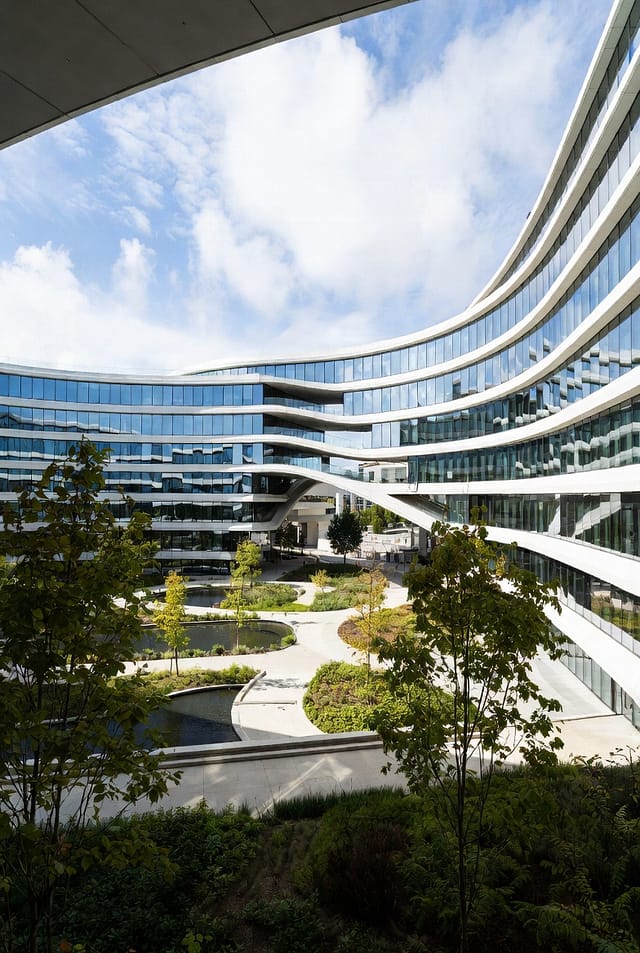
Adaptive & Flexible Design: Architecture as Response and Continuity
Adaptation is the architecture of survival. Flexibility is the architecture of meaning. To build for change is to acknowledge the temporal nature of human life — its contingencies, transitions, disruptions, and possibilities.
Why Adaptation Matters
Adaptive design arises from necessity. It responds to conditions that are unpredictable or evolving — climate extremes, shifting patterns of work and living, aging populations, fluctuating social needs, and pandemic aftershocks. What was once an architectural option has become a structural imperative because the world itself has become unstable by historical standards.
Adaptation is not reactive. It is anticipatory. Homes designed with adaptable thresholds, offices with adjustable partitions, and neighborhoods with mixed-use capacity are not merely conveniences; they are architectural strategies for resilience.
The Difference Between Flexible and Adaptive
“Flexible” design emphasizes configurability — spaces that can be rearranged or repurposed without major alteration. “Adaptive” design goes further: it anticipates change and allows structures to evolve in response to new circumstances over time. Flexibility is horizontal; adaptation is temporal.
An apartment with movable partitions is flexible. A building that anticipates future expansion, alternative uses, or environmental shifts is adaptive. Both are responses to uncertainty, but adaptability acknowledges time as a material just as real as brick or steel.
Climate and Adaptive Architecture
Climate change has transformed the stakes of design. Sea-level rise, heat waves, floods, and storms make static solutions untenable. A design that works today may be obsolete or unsafe tomorrow. This is why adaptive design is not stylistic; it is functional and ethical.
Climate-responsive design acknowledges local conditions as inextricable from structure. The vernacular architecture of regions around the world — from wind-catchers in desert climates to stilt houses in flood zones — grew from centuries of experience adapting to environmental forces. Contemporary adaptive design does not reject this inheritance; it updates it with science and foresight.
Workplaces in Transition
The meaning of work has shifted dramatically in recent years. Remote work, hybrid schedules, and digital collaboration have unsettled conventional office typologies. What was once a well-defined workplace has become an elastic concept — part studio, part home, part virtual realm.
Adaptive design for workspaces prioritizes reconfigurability and multi-functionality. Walls become tools for acoustics and privacy, not barriers. Circulation becomes convertible. Offices become “third spaces” with fluid boundaries, reflecting how work and life are increasingly interwoven.
Homes That Evolve with Life
A dwelling is often inhabited across decades, through life stages: single life, coupledom, parenthood, aging — each phase with distinct spatial needs. A home that cannot evolve across these phases risks becoming obsolete, disinvested, or emotionally dissonant.
Adaptive residential design anticipates this life arc. Bedrooms become offices; playrooms become studios; outdoor spaces evolve with seasons and family rhythms. These adaptations reflect a humane understanding of home not as static shelter, but as a *longitudinal environment for a life in motion*.
Public Space as Adaptive Commons
Public space is where adaptability meets community. Parks, plazas, streets, and shared zones transform with use and time. An adaptive plaza accommodates performances, markets, protests, and rest. It is not frozen in a single program but is open to collective reimagination.
Public adaptability is civic adaptability. It acknowledges that cities are not finished products but evolving ecosystems shaped by human action, culture, and necessity. A street that can be reclaimed for pedestrians, vendors, and festivals becomes a living document of collective life, not a rigid transportation corridor.
Adaptive Infrastructure and Equity
Infrastructure that cannot adapt often reinforces inequity. Systems that serve one demographic well may marginalize another. Mobility networks must adjust for accessibility, affordability, and density. Water systems must manage climate volatility. Energy grids must integrate decentralized production without abandoning those who lack access.
Adaptive infrastructure is not a luxury. It is a matter of justice — a preparation for scenarios that disproportionately affect vulnerable communities. A resilient design is one that anticipates and accommodates the diversity of lived conditions.
The Practice of Adaptation
Adaptive design is not a singular style or a checklist. It is a *practice* — a way of thinking about context, evidence, change, and consequence. It insists that architects and designers consider not just how a space functions today, but how it will function under stress, transformation, and unforeseen future conditions.
This practice demands humility. It acknowledges that no single design can predict every future, but a design can create structure for learning, adjustment, and evolution. The design process becomes an ongoing conversation between form and life, not a closed event sealed by completion.
Documentation and Adaptive Legacy
Adaptive design acknowledges that buildings have lives beyond the completion of construction. Documentation — models, drawings, performance metrics, and post-occupancy evaluation — becomes crucial. These records make future adaptation legible and actionable.
Architecture that anticipates its own revision creates a legacy of knowledge, not just a physical artifact. It invites future stewards — residents, custodians, communities — into a practice of care rather than abandonment.
This archival dimension is a cultural good: it teaches future generations how design responded to conditions of uncertainty, climate upheaval, and social transformation.
Rethinking Obsolescence
Traditional models often treat buildings as static objects whose value diminishes over time. Adaptive design challenges this premise. Obsolescence is not inevitable if architecture is conceived as a *temporal field* rather than a fixed object.
Adaptive design transforms obsolescence into opportunity — not by denying decay but by accommodating change. Roof decks become gardens, vacant offices become residential units, parking structures become community hubs. The life of the built environment becomes a series of adaptive chapters.
Questions for Adaptive Futures
If adaptation is a measure of resilience and dignity, then every design choice becomes a question about future conditions: How will this space respond to climate extremes? How will it accommodate shifting patterns of living and working? How does it serve both present and future communities?
These questions are not decorative. They are ethical, social, ecological, and cultural. They sit at the intersection of how humans anticipate change and how environments shape human life in return.
Home |
About |
Process & Practice |
Contact
