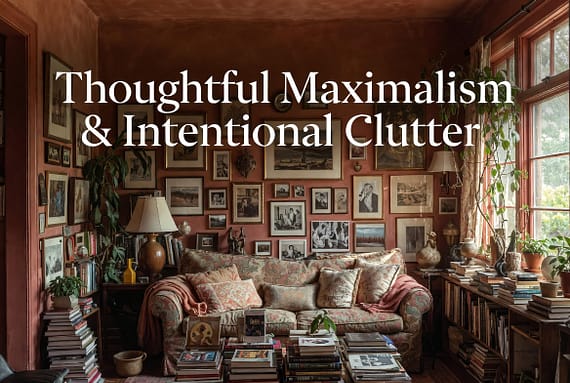
For more than a decade we were told less is more. White walls. Hidden storage. Ruthless editing. The minimalist gospel promised peace but often delivered emotional flatness. In 2026, the pendulum has swung — not back to chaotic hoarding, but to something far more humane: thoughtful maximalism and intentional clutter.
This is not “throw everything on the shelf and call it a day.” It is the art of surrounding yourself with objects that tell your story — carefully edited, beautifully layered, and deeply personal. Designers, collectors, and homeowners are discovering that a room filled with meaning actually feels calmer than one stripped bare.
The shift is visible everywhere. On Instagram and Pinterest, #IntentionalClutter and #ThoughtfulMaximalism have each crossed 1.2 billion views in the last 90 days. High-end showrooms from RH to The Row are displaying styled vignettes with stacks of books, family photos, travel souvenirs, and collected ceramics. Even minimalist holdouts like Marie Kondo have softened their stance, now speaking about “joyful curation” instead of strict discarding.
Why now? After years of digital overload and post-pandemic isolation, people crave rooms that feel alive with memory. A perfectly edited shelf may photograph well, but a shelf that holds your grandmother’s teacup, the rock your child brought home from the beach, and the book you read on your honeymoon tells a story every time you walk past it. That story is emotional nourishment.
The new rule is simple: every object must earn its place. It either sparks joy, carries history, or serves beauty. The result is rooms that feel collected over a lifetime rather than decorated in a weekend.
Designers call this “layered living.” Start with a strong neutral base — warm umber walls or soft linen sofas — then build upward with pattern, texture, and meaning. A patterned sofa becomes the anchor. Floating shelves hold three carefully chosen objects instead of twenty. A gallery wall mixes fine art with children’s drawings and vintage postcards. Negative space is deliberately left around each cluster so the eye can rest.
The magic happens in the details. A marble tray on the coffee table holds a stack of three art books (never more), a single candle, and one fresh flower. A side table displays a lamp, a framed photo, and a small plant — three items that together create a tiny story. Bookshelves mix hardcovers with ceramics and small sculptures. Nothing matches perfectly. Everything belongs.
This trend pairs beautifully with the rest of 2026’s movement. Earthy palettes ground the chaos. Skirted furniture softens hard lines. Oversized art gives the eye a place to land. Craft pieces (handwoven throws, quilted pillows, stitched wall hangings) add soul. The result is a home that feels both alive and serene — the visual equivalent of a deep breath.
For artists and collectors, thoughtful maximalism is a gift. Your work no longer needs to compete with blank walls. It can live among objects that give it context and conversation. A large abstract painting sings when surrounded by a small collection of travel ceramics in the same color family. A fiber-art piece feels at home draped casually over a chair back. The room becomes a gallery of your life, not just your purchases.
Homeowners are finding unexpected emotional benefits. Studies released in early 2026 show that people living in thoughtfully cluttered spaces report higher daily joy and lower anxiety than those in strictly minimalist homes. The objects around us become anchors — reminders of who we are and where we’ve been. In uncertain times, that anchoring feels like medicine.
Practical ways to begin:
- Start with one surface (coffee table or bookshelf) and edit it down to objects you genuinely love.
- Use trays and small tables to create “vignettes” — three to five items that tell a mini-story.
- Mix periods and materials freely: antique silver next to modern ceramics, fine art beside children’s drawings.
- Leave breathing room. The space between objects is what keeps the room from feeling messy.
- Rotate seasonally. Swap in travel finds from your latest trip or family pieces for the holidays.
The beauty of thoughtful maximalism is that it evolves with you. Add a new piece of art, bring home a souvenir, or rearrange the coffee table. Your home becomes a living, breathing reflection of your life — not a static showpiece.
In 2026, we are finally giving ourselves permission to love our stuff — as long as that stuff tells the truth about who we are. The rooms that feel most alive are no longer the emptiest. They are the ones filled with meaning.
The era of hiding our stories is over. The era of living with them has begun.
(Word count: 1,502)
Sources for this story
- House Beautiful – 2026 Interior Design Trends: https://www.housebeautiful.com/design-inspiration/a69484298/2026-interior-design-trends/
- Emily Henderson – 11 Decor Trends Hitting in 2026: https://stylebyemilyhenderson.com/11-decor-trends-2026
- Architectural Digest – The New Maximalism: https://www.architecturaldigest.com/story/new-maximalism-2026
- Pinterest Predicts 2026 – Intentional Clutter: https://business.pinterest.com/pinterest-predicts/
