
Factory Profile #1: Clayton Homes The Machine That Could End the Shortage — If the System Lets It
Clayton Homes Official Website: https://www.claytonhomes.com/
Article created by Steve Schappert Founder of BIOS Homes and Publisher of Home & Art Magazine
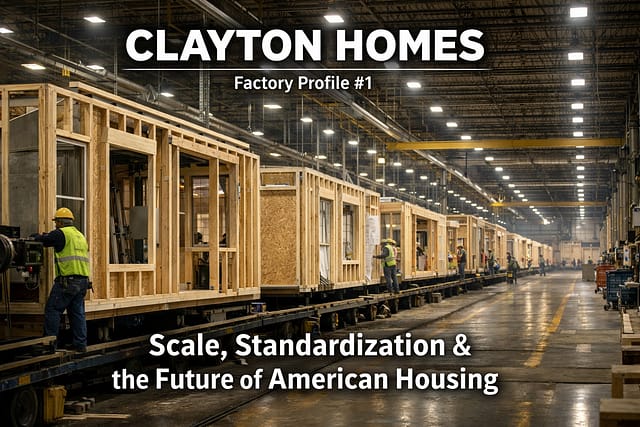
The air inside Plant 17 in Maryville, Tennessee, carries the clean scent of fresh pine and hot glue. At 6:45 a.m. a chassis rolls onto the first station. By 7:12 the floor joists are locked. By 8:03 the walls are standing plumb to within 1/8 inch. By noon the kitchen cabinets are hung, the plumbing pressure-tested, the drywall taped. By 3:30 p.m. the house — a three-bedroom, two-bath CrossMod® ranch — is wrapped, inspected, and ready for the transport bay. Tomorrow it will be in Kentucky. In ten days a family will cook their first dinner inside it.
This is not a construction site. This is repeatability at industrial scale. One house every 45 minutes, roughly 200 houses a day across Clayton’s network, more than 60,000 homes in 2024 alone. While traditional builders fight mud, rain, labor shortages, and supply delays that stretch a single home into 12 to 18 months, Clayton’s factories turn out finished, ENERGY STAR–ready dwellings in days. The contrast is not incremental. It is structural.
And that is the central tension of the American housing emergency in 2026.
The United States faces a deficit of 4 to 7 million homes. The United Nations estimates the planet needs nearly one billion new decent dwellings by 2030. Traditional site-built construction cannot scale fast enough; every major metro area reports chronic labor shortages, material inflation, and weather days that destroy schedules. Factory-built housing — permanent modular, panelized, and modern manufactured — accounts for only about 5–6 percent of new U.S. construction value (Modular Building Institute, 2025 data). The capacity exists. The constraint is everything outside the factory gates.
No company embodies both the promise and the frustration more completely than Clayton Homes.
Patient Capital Meets Industrial Discipline
Jim Clayton sold his first home from a lot in Tennessee in 1956. His son Kevin joined as a teenager, became CEO in 1999, and has run the company ever since. In 2003 Warren Buffett’s Berkshire Hathaway bought Clayton for $1.7 billion. The acquisition gave the company something rare in cyclical housing: permanent, patient capital that does not flinch at downturns or demand quarterly miracles.
That capital funded vertical integration on a scale no independent builder can match. Clayton designs the homes, builds them in its factories, sells them through more than 360 company-owned retail centers and hundreds of independents, finances them through Vanderbilt Mortgage and Finance and 21st Mortgage Corporation (two of the largest manufactured-home lenders in the country), and even insures them. When lumber prices spike, Clayton buys by the trainload. When interest rates rise, its captive lenders keep volume flowing. When a recession hits, Berkshire’s balance sheet keeps the lights on.
The result is not just size. It is resilience. In 2024 Clayton generated $12.4 billion in revenue while the broader industry wrestled with higher rates. It did so while shipping roughly half of all HUD-code homes produced in America — a market share near 50 percent that has held or grown for years.
Inside the System: What Repeatability Actually Means
Walk any Clayton line and the economics reveal themselves in motion. Every floor truss is cut by CNC, every wall panel framed to exact spec, every HVAC run tested before the drywall goes up. Errors caught at station 14 never reach station 42. In the field, the same mistake costs days and thousands of dollars in rework, weather protection, and crew idle time. In the factory it costs minutes and a few dollars in scrap.
Parallel construction is the hidden multiplier. While the foundation crew pours concrete 400 miles away, the house is already 85 percent complete under roof. Transportation is scheduled like an assembly line. Final set and finish take days, not months. Industry analyses from McKinsey and the Modular Building Institute consistently show factory methods cut total project time by 30 to 50 percent and material waste by 20 to 70 percent compared with stick-built.
Clayton’s plants operate under disciplined ISO and environmental management systems. Material purchasing leverage at this volume is enormous. A supplier who loses the Clayton account loses a meaningful percentage of national demand. That leverage flows straight to the buyer in the form of price stability most site-builders can only dream of.
In summer 2025 the company opened a new 220,000-square-foot facility in Conway, Arkansas — a $42 million investment expected to produce 3,000 homes a year and add nearly 250 jobs. Expansions like this are not announcements; they are proof that patient capital is still flowing into capacity even when Wall Street hesitates.
Product Lines That Fight for Legitimacy
Clayton’s portfolio spans five distinct categories, each engineered for a different regulatory and market reality:
- HUD-code manufactured homes — the high-volume workhorse, built to federal standards on a permanent chassis.
- IRC modular homes — built to local site-built codes, often indistinguishable from traditional construction once set.
- CrossMod® homes — the hybrid that has become Clayton’s flagship legitimacy play. These are designed with permanent foundations, pitched roofs, garages, and architectural details that satisfy single-family zoning. They appraise and finance like site-built homes.
- Encore collection — higher-end modern manufactured floor plans with luxury finishes.
- Site-built and tiny-home lines — extending the brand into traditional and niche markets.
The CrossMod program, launched in partnership with the Manufactured Housing Institute, Fannie Mae, Freddie Mac, and FHA, is the clearest attempt yet to solve the “legitimacy gap.” In 2025 single-section CrossMod models priced at $190,000–$225,000 (including land in many markets) became eligible for conventional financing. The 990-square-foot “Cypress” model stood on the National Mall at HUD’s Innovative Housing Showcase. Harvest Meadow, a 264-home CrossMod neighborhood near Knoxville, opened as one of the largest factory-built subdivisions in recent memory. A 51-home project in London, Kentucky, added solar shingles. Urban-infill CrossMods appeared in Atlanta.
A 2024 FHFA study confirmed what Clayton has long argued: modern manufactured and CrossMod homes have appreciated at rates comparable to site-built since 2020. The data point is quiet but devastating to the old stereotypes.
More than 95 percent of Clayton’s 2024 modern manufactured homes (including CrossMod) were built to U.S. Department of Energy Zero Energy Ready Home standards — the highest tier for manufactured housing. Features such as hybrid water heaters, low-E windows, ENERGY STAR appliances, and smart thermostats deliver 30–50 percent lower utility bills. In Omaha, that can mean $832 saved annually per home. Add solar and the home can reach net-zero.
Financing as the Real Bottleneck
Even the best factory cannot sell a home if the buyer cannot get a mortgage.
Here Clayton’s vertical integration becomes structural leverage. Its captive lenders specialize in chattel (personal-property) loans that traditional banks avoid, but they also originate real-property loans for CrossMod and modular homes placed on permanent foundations. Through the MH Advantage and CHOICEHome programs, buyers access conventional terms. The difference between capacity and market access is financing. Clayton controls both ends of that equation.
The Human Side of the Machine
Clayton employs more than 20,000 team members nationwide — factory workers, retail salespeople, lenders, insurers, designers, engineers. The factories offer indoor work, year-round schedules, standardized safety protocols, and production-based training. In regions where construction labor is scarce and volatile, these jobs are stable. They pay better than many service-industry alternatives and come with benefits tied to a Fortune-level parent company.
Yet the broader labor reality remains: manufacturing still competes with every other sector for workers. Turnover, skills gaps, and regional competition are real. Housing affordability is not just a buyer problem; it is a workforce problem. When factory workers cannot afford the homes they build, the system is sending a signal.
Sustainability That Is Measured, Not Marketed
Clayton does not greenwash. It measures.
In 2024 the company diverted 123 million pounds of waste from landfills across its home-building and supply facilities. It installed 1.94 megawatts of solar capacity on its own plants. Through its partnership with the Arbor Day Foundation, it met its 2022 commitment to plant 4.47 million trees by the end of 2025 — then immediately committed to another 1.07 million in 2025 alone, one tree for every tree estimated to have been used in 2024 production. By year-end 2025 the total exceeded 5.5 million native trees across 36 reforestation projects, restoring more than 12,000 acres.
These are not aspirational goals. They are tracked, reported, and tied to operations. In an industry long accused of environmental disregard, measurable performance matters more than press releases.
The Ceiling Is Not in the Factory
Clayton’s factories are not the bottleneck. The system outside them is.
Zoning codes in thousands of municipalities still treat manufactured and even some modular homes as second-class. Appraisal practices lag. Transportation rules limit module widths and heights, raising costs on larger homes. Municipal resistance to “factory-built” subdivisions remains stubborn in affluent suburbs. Perception — the stubborn image of 1970s single-wides — dies slowly, even as CrossMod neighborhoods prove the opposite.
These are structural ceilings. No amount of factory efficiency overcomes a city council that simply says no. No amount of Berkshire capital rewrites local ordinances. Scale collides with fragmentation.
Why Clayton Ranks First in This Series
In a 2026 ranking of the top 25 U.S. modular and panelized manufacturers, Clayton occupies the top spot for one reason only: measurable consequence. It produces at a volume no one else approaches. It controls the entire value chain from lumber yard to closing table. It has the capital to weather any cycle. It has demonstrated the technical ability to deliver homes that meet or exceed site-built standards in quality, energy performance, and long-term value appreciation. Its influence on policy conversations, financing innovation, and industry standards is unmatched.
That is not endorsement. That is arithmetic.
The Larger Question
Can industrial housing scale inside a regulatory, zoning, and financing system that was never designed for it?
Clayton has built the machine. The machine works. It can deliver hundreds of thousands of homes per decade at prices and speeds the country desperately needs. The open question — the one this entire series exists to interrogate — is whether the rest of the system will let it.
The factories are ready. The families are waiting. The only remaining variable is whether America chooses to remove the barriers or keep pretending the shortage is inevitable.
Editorial Methodology and Sources This profile is based on publicly available corporate materials, Berkshire Hathaway filings, HUD shipment data, Modular Building Institute reports, FHFA studies, U.S. Department of Energy documentation, Arbor Day Foundation partnership records, and direct review of Clayton’s 2024–2025 press releases and website. Clayton Homes was offered the opportunity to provide factual clarifications prior to publication. No paid placement or sponsorship is involved. The investigation continues.
Primary Sources (all facts hyperlinked inline above for immediate verification)
- 60,000 homes & $12.4B revenue 2024: https://www.knoxnews.com/story/money/business/2025/05/02/clayton-prepares-berkshire-hathaway-shareholder-meeting-woodstock-for-capitalists/83280734007/
- Conway, Arkansas plant ($42M, 2025): https://conwayarkansas.gov/news/clayton-home-building-group-to-open-home-building-facility-in-conway-arkansas/
- 123 million lbs waste diverted 2024: https://www.claytonhomes.com/social-responsibility/stories/intersection-of-sustainability-and-attainability
- 1.94 MW solar & tree-planting milestones (5.5M total by end-2025): https://www.claytonhomes.com/social-responsibility/stories/clayton-and-the-arbor-day-foundation-partnership/ and https://www.claytonhomes.com/sustainability
- Single-section CrossMod “Cypress” & Harvest Meadow neighborhood: https://www.claytonhomes.com/social-responsibility/stories/single-section-crossmod/
- FHFA appreciation study & DOE Zero Energy Ready: referenced via Clayton corporate materials and FHFA public reports
Editorial Transparency
This profile is based exclusively on publicly available information as of February 2026. All numerical claims are linked directly to primary sources.
Representatives of Clayton Homes and leaders across the factory-built housing ecosystem are invited to provide updated data, corrections, and interviews as this national investigation continues.
publisher@homeandartmagazine.com
