
Why Modular Can’t Scale (Yet)
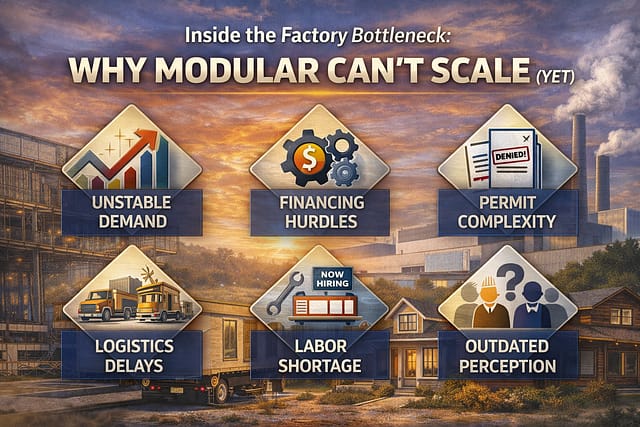
America’s modular factories are not failing because they can’t build. They’re failing to scale because the rest of the housing system still behaves as if factories don’t exist.
The U.S. is short millions of homes—one widely cited estimate put the deficit at 4.7 million as of mid-2025—yet even as demand rises, the factory-built sector remains a small slice of the pie. The paradox is not productivity. It’s friction: financing, codes, permitting, logistics, land, and the perception gap between what modular is and what the public still thinks it is.
This page documents the obstacles factory leaders quietly navigate every day—the real-world constraints that determine whether a plant runs at capacity or sits underutilized, whether a developer signs a second contract or returns to site-built, and whether modular becomes America’s fastest path to housing abundance—or stays an industry that “should be bigger.”
1) Demand Exists. Predictable Demand Doesn’t.
Traditional builders can pace starts as sales pace. Factories can’t.
Modular manufacturing works best with stable throughput: repeatable designs, planned procurement, steady crews, and predictable schedules. But housing demand arrives in cycles—interest rates shift, permits stall, investors pause, and projects die midstream. When a single multi-family deal delays, a factory doesn’t lose a week; it can lose a production slot that was scheduled months in advance.
McKinsey notes that modular has produced strong performers but also high-profile failures—often rooted in commercialization complexity and the difficulty of scaling without consistent pipelines.
What this means for factories: sales volatility becomes operational volatility, and operational volatility becomes higher unit cost—exactly what modular is supposed to avoid.
2) The Financing Mismatch: Factories Build Fast, Capital Moves Slow
A factory can produce a building in weeks. Project financing often can’t.
In conventional construction, lenders fund work in place over time. In modular, large portions of cost move upstream—paid earlier, off-site, sometimes before the bank’s inspection logic even knows how to verify it. The result is a systemic mismatch between how modular is manufactured and how real estate is financed.
A 2024 National Renewable Energy Laboratory (NREL) case study lays out why financing modular projects—especially multifamily—can be difficult, including payment timing, lender comfort, risk allocation, and process uncertainty.
What this means for factories: even when the end buyer exists, projects can stall because the money flow was designed for mud-and-rain construction, not controlled manufacturing.
3) Permitting and Code Fragmentation: “Built in the Factory, Blocked in the Permit Office”
Modular is standardized inside the plant—but often customized at the permit counter.
Unlike HUD Code manufactured housing, permanent modular generally must comply with state and local building codes, and those vary widely by jurisdiction. When every town requires a unique set of details, a factory loses one of its core advantages: repeatability.
Policy analysts have increasingly pointed to code fragmentation as a cost driver that forces projects to become bespoke. The Center for American Progress has argued that more uniform rules would enable manufacturers to streamline production and reduce costs.
There are signs of progress. Virginia, for example, adopted ICC/MBI 1200/1205 off-site construction standards—an attempt to modernize oversight for factory-built methods. But these adoptions remain uneven, and many regions still treat modular like an exception rather than a normal form of construction.
What this means for factories: every new jurisdiction can feel like a new product line—even if the home is identical.
4) Logistics: Transportation, Crane Time, and Site Readiness Can Erase the “Speed Advantage”
The factory can deliver precision. The jobsite must still be ready to receive it.
Modular construction doesn’t eliminate site work—it compresses it. That compression is powerful, but it also concentrates risk:
-
Oversize-load transportation constraints (routes, escorts, permits, timing)
-
Crane availability and crane cost spikes
-
Set crews and site supervisors with modular experience (still scarce)
-
Foundations, utilities, and inspections needing to align perfectly
Industry commentary increasingly highlights how transportation and crane costs can eat into savings if projects aren’t designed around logistics from day one.
What this means for factories: manufacturing certainty can collide with site uncertainty. When that happens, modular doesn’t just get delayed—it gets blamed.
5) Workforce Reality: Modular Helps the Labor Crisis, but Doesn’t Escape It
Factories reduce on-site labor, improve safety, and allow training in controlled conditions—but they still require skilled labor: framers, electricians, plumbers, finish carpenters, quality inspectors, and production managers.
Industry analysis routinely lists labor shortages among the forces pushing builders toward industrialized methods—yet those same shortages also constrain factories’ ability to expand quickly.
What this means for factories: modular is a solution to construction labor scarcity, but it still competes in the same labor market—often without the cultural prestige or recruiting pipeline of other manufacturing sectors.
6) Perception Is a Supply-Chain Problem
If buyers, appraisers, lenders, municipalities, and developers misunderstand modular, the whole pipeline slows.
This is why the sector can remain small even when the math is obvious. MBI’s industry analysis shows modular is already a multi-tens-of-billions market in the U.S., but still a modest share overall. The growth ceiling isn’t technical—it’s narrative infrastructure.
The factories are building the future; the public is still using yesterday’s vocabulary.
The Series Promise: We Won’t Just Celebrate the Winners—We’ll Document the Friction
This investigation exists to tell the story the market keeps missing:
-
What’s working inside the best factories
-
What’s blocking scale outside them
-
What needs to change (financing, code alignment, permitting modernization, logistics planning, and marketing clarity)
Because the housing crisis is not waiting for perfect conditions.
And modular—properly understood, properly financed, properly permitted, properly marketed—may be the fastest path we have.
Submissions and Press Materials
If you’re a manufacturer, developer, lender, code official, or industry partner and want your plant, data, or projects considered for upcoming profiles, send materials to:
Publisher, Home & Art Magazine
publisher@homeandartmagazine.com
