
Where Food Becomes Inheritance — Tradition, Migration, and the Taste of Time
Memory does not live in the mind alone.
It lives in the mouth.
Before photographs, before written recipes, before family archives, there was taste. A spice blend remembered by hand. A soup simmered without measurement. Bread folded the way a grandmother once folded it. Food carries memory across generations with a precision few other mediums can match.
If land is origin, fire is transformation, and table is gathering, then memory is continuity.
Food remembers where we came from.
Across cultures, recipes function as oral history. Techniques are passed not through instruction manuals but through repetition. A child stands beside a parent at the stove. Measurements are approximated: “a handful,” “until it smells right,” “until the color deepens.” The body learns what the mind may not articulate.
These gestures outlast language.
Migration intensifies this relationship. When families move—across borders, across oceans, across economic realities—they carry food with them. Spices travel in luggage. Seeds are smuggled in pockets. Techniques adapt to new climates and available ingredients. What cannot be transported physically is reconstructed emotionally.
Cuisine becomes anchor.
In immigrant communities, the kitchen often becomes the first site of belonging. Ingredients unfamiliar to the new landscape are sought in small specialty markets. Recipes are adjusted to match substitute produce. Over time, hybrid forms emerge—fusion not as trend, but as necessity.
Italian-American red sauce differs from its regional origins in Italy. Tex-Mex evolved from borderland adaptation. Caribbean dishes reflect layered colonial histories. Food absorbs geography while retaining memory.
Taste becomes map.
Every region’s cuisine reflects its migrations—forced or chosen. Enslaved peoples carried culinary techniques that reshaped Southern American food. Jewish diaspora communities preserved recipes across continents. Southeast Asian refugees rebuilt food cultures in new climates. The story of a place can often be read on its plate.
Food preserves identity when other structures erode.
Memory is also seasonal. The first apple of autumn, the citrus brightness of winter, the heavy stews of colder months. Seasonal eating aligns present experience with ancestral rhythms. Even when supermarkets offer strawberries year-round, the taste of them in summer carries different weight.
Anticipation deepens memory.
Holiday meals crystallize this phenomenon. Thanksgiving turkey, Lunar New Year dumplings, Ramadan iftar spreads, Passover seders, Diwali sweets. These meals are not consumed casually. They are staged, rehearsed, remembered. Recipes may evolve slightly, but their emotional architecture remains constant.
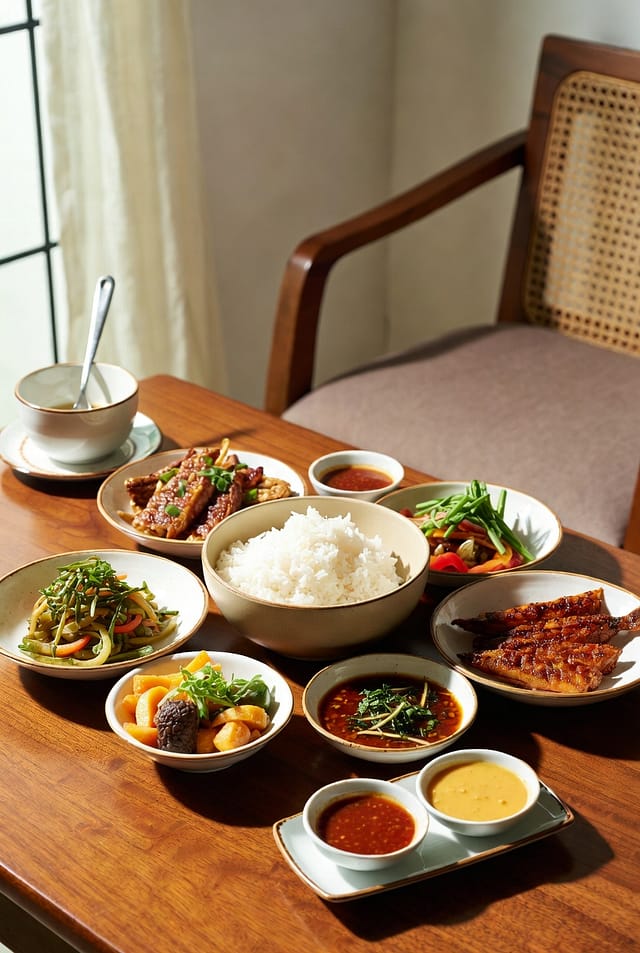
The table becomes archive.
Even absence shapes food memory. The chair that remains empty. The dish no one else can quite replicate. The spice ratio slightly off without the original hand guiding it. Loss intensifies taste.
Neuroscience confirms what tradition already knew: smell and taste are directly linked to memory centers in the brain. A single bite can collapse decades. The scent of garlic sautéing may return someone to childhood instantly. A particular dessert can resurrect a long-gone kitchen.
Memory through food is involuntary and visceral.
Restaurants that endure understand this. They do not chase novelty alone. They recreate comfort. They refine nostalgia. They serve dishes that feel familiar even when first encountered. Diners return not only for flavor, but for emotional continuity.
Yet memory is not static.
Younger generations reinterpret inherited recipes. Health concerns shift ingredients. Sustainability concerns alter sourcing. Technology introduces convenience. The essence remains, but expression evolves. This is how culture survives—not through preservation alone, but through adaptation.
Grandmother’s stew may become plant-based. Traditional bread may be gluten-adjusted. Fermentation methods may be refined with temperature control. The heart of the dish persists.
Memory allows evolution without erasure.
Food also carries collective memory of hardship and resilience. Depression-era recipes reflect scarcity—stretching ingredients, maximizing leftovers. War-time substitutions redefined staple dishes. Drought and famine reshaped agricultural practices. These experiences imprint themselves onto cuisine.
What a culture eats reveals what it endured.
In real estate and development, the intersection of food and memory becomes spatial. Historic neighborhoods often retain culinary identity. Bakeries that have operated for generations anchor community memory. Markets serve as living archives of migration and trade.
When redevelopment erases these spaces, memory fragments.
Preserving culinary institutions can be as significant as preserving architecture. A century-old deli holds narrative weight. A family-owned restaurant embodies neighborhood continuity. Food businesses are not simply commerce; they are cultural infrastructure.
Digital culture complicates food memory. Recipes are now archived online, photographed, and shared instantly. Social media platforms transform private meals into public display. Yet digital abundance does not replace embodied memory. Watching a recipe video is different from learning by touch.
Memory requires participation.
Cooking inherited dishes reconnects individuals to lineage. It recreates gesture and timing. It honors those who cooked before. Even imperfect replication sustains continuity.
Food also shapes future memory. Children growing up today will associate certain flavors with their own milestones—school lunches, holiday cookies, backyard barbecues. What we cook now becomes someone else’s nostalgia later.
Memory is forward-facing.
The responsibility embedded in that reality is subtle but profound. How we source food, how we prepare it, how we gather around it—these choices influence what future generations remember as normal, as celebratory, as comforting.
Land begins the process. Fire changes it. Table gathers it. Memory sustains it.
Without memory, food becomes commodity alone—interchangeable, disposable, detached from origin. With memory, food becomes inheritance.
A simple recipe card, stained with use, may hold more cultural weight than a museum artifact. A handwritten note in the margin—“add more salt if needed”—captures voice beyond language.
Food remembers the hands that made it.
It remembers migration routes, climate shifts, economic transitions. It remembers survival strategies and celebrations alike. It carries geography into kitchens far from its origin.
And in every bite, it reminds us that we are part of a continuum.
Memory is not nostalgia.
It is structure.
It is the thread connecting soil to stove to story.
And as long as meals are shared, memory will remain seated at the table.
