
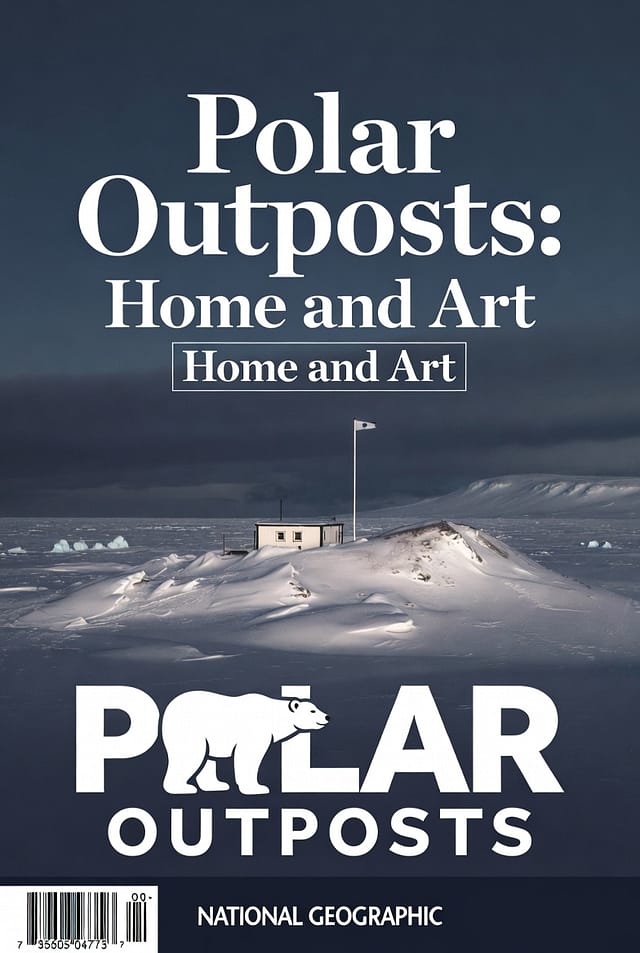
Polar Regions: Where Humanity Learns the Cost of Survival
The polar regions are not margins of the world — they are its mirrors. In ice, darkness, and silence, human life is stripped to essentials. To live at the poles is to confront cold, isolation, and time itself, revealing what shelter, community, discipline, and meaning truly require.
The Cold as a Total Condition
In polar environments, cold is not weather — it is an organizing force. It shapes movement, metabolism, material choice, time, and social behavior. Mistakes are not inconvenient; they are dangerous.
In the polar regions:
- exposed skin becomes a liability
- materials fracture under thermal stress
- fuel, food, and heat become existential resources
- movement must be deliberate and planned
Cold teaches discipline. It does not allow improvisation without consequence.
Shelter as Collective Infrastructure
Polar shelters are not expressions of individuality. They are systems designed for shared survival. Insulation, airlocks, redundancy, and compact planning define polar architecture.
These structures prioritize:
- thermal continuity
- protection from wind and exposure
- reliable energy and fuel access
- spatial efficiency under confinement
In the polar regions, architecture becomes an extension of the body — preserving heat, conserving energy, and enabling life where the environment offers none.
Material Intelligence Under Ice
The polar regions are unforgiving to material failure. Metals become brittle. Plastics crack. Mechanical systems slow or seize. Design decisions are made with an understanding that repair may be impossible.
As a result, polar construction emphasizes:
- durability over novelty
- simplicity over complexity
- redundancy over efficiency alone
- maintenance as a core design principle
These choices reflect a worldview where longevity matters more than spectacle.
Time, Darkness, and Human Psychology
Polar life alters time. Months of darkness or continuous daylight disrupt circadian rhythms, perception, and emotional stability. The absence of visual variation challenges the human mind.
To endure, polar communities rely on:
- structured routines
- shared rituals and meals
- artificial light as psychological support
- spaces for solitude within proximity
In these conditions, architecture and interior design become tools of mental survival as much as physical protection.
Community Over Individualism
Isolation at the poles reveals the limits of self-reliance. Survival depends on trust, coordination, and shared responsibility. There is little tolerance for social fracture.
Polar communities cultivate:
- mutual dependence
- collective decision-making
- respect for shared resources
- conflict resolution as survival skill
These environments make visible a truth often obscured elsewhere: **community is infrastructure**.
Art and Meaning in a White World
In landscapes defined by monotony and absence, art becomes orientation. Color, music, writing, and small acts of creative expression provide continuity with human identity.
In polar habitats, art serves to:
- counter sensory deprivation
- mark time and personal identity
- maintain emotional resilience
- preserve cultural connection
These gestures are not indulgent. They are necessary.
Indigenous Knowledge and Arctic Survival
Long before modern research stations, Indigenous Arctic cultures developed profound knowledge systems rooted in observation, restraint, and adaptation. Clothing, shelter, movement, and diet evolved in dialogue with ice, animals, and seasonal rhythms.
These cultures demonstrate that survival in polar regions is not about conquest, but relationship — with land, weather, and community memory.
The Polar Regions and Planetary Truth
The poles are not isolated from the rest of the world. They are indicators. Melting ice, shifting ecosystems, and destabilized permafrost reveal changes occurring at planetary scale.
What happens in the polar regions signals:
- global climate shifts
- sea level rise
- ecological imbalance
- feedback loops affecting all regions
The poles are not remote. They are early warnings written in ice.
The Ethics of Presence
Building and living in polar regions raises ethical questions:
- What impact do human structures have on fragile ecosystems?
- Who benefits from polar research and exploration?
- What responsibilities accompany access?
- How do we avoid extraction disguised as discovery?
The polar regions demand humility. They punish arrogance and reward care.
Reading the Poles as Evidence
When we study polar regions, we see:
- what humans need when comfort disappears
- how communities function under isolation
- which systems endure under extreme stress
- how meaning persists without abundance
These landscapes are not blank. They are records — precise, unforgiving archives of human adaptation.
Final Questions on the Polar Regions
If architecture answers how we live together and art answers why it feels the way it does, then the polar regions ask: *How do we live when warmth is never guaranteed? What does home mean when survival depends on others? And what do these environments reveal about the future of life on a changing planet?*
The polar regions do not offer comfort. They offer truth — and the discipline required to live within it.
Home |
About |
Desert |
Frontier Habitats
