
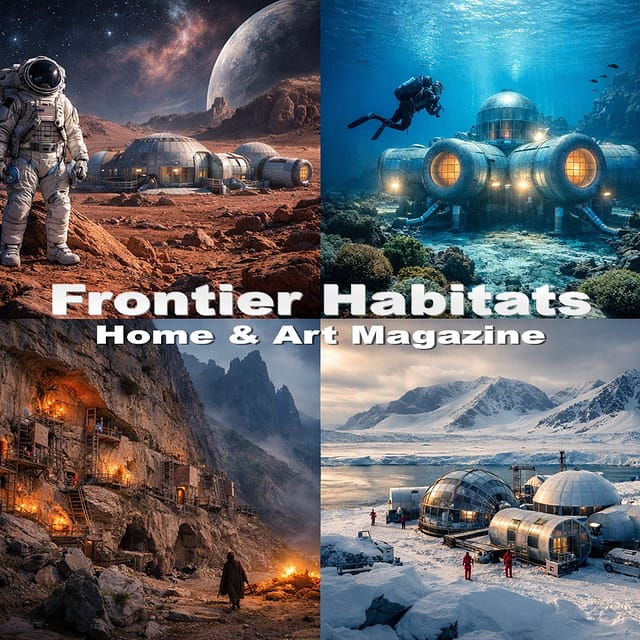
 What Makes a Habitat a Frontier
Frontier Habitats: How Humanity Learns to Live at the Edges
Frontier habitats are not simply remote places or experimental shelters. They are the environments where human life is tested against limits — ecological, climatic, technological, psychological, and cultural. To study frontier habitats is to observe humanity learning, in real time, how to adapt, endure, and redefine what it means to live well.
A frontier habitat exists where environmental forces challenge ordinary life. These conditions may include:
- extreme temperature variation or sustained heat and cold
- limited access to water, food, or energy
- geographic isolation from supply chains and services
- ecological fragility requiring careful balance
- psychological strain from remoteness or confinement
In these contexts, design is not aesthetic first — it is existential. Shelter must perform. Systems must work. Communities must adapt or fail.
Habitability Under Constraint
Frontier habitats strip living down to essentials. They force clarity around what humans actually need to survive and thrive:
- thermal stability
- clean air and water
- reliable energy
- psychological comfort and social connection
- rhythms that support rest, work, and meaning
These environments expose how fragile many modern assumptions are — and how resilient human ingenuity can be when those assumptions collapse. In frontier habitats, every system is visible. There is no hiding inefficiency or excess.
Architecture as Survival Knowledge
Frontier architecture is less about expression and more about intelligence. Materials are chosen for durability, availability, and performance. Forms respond directly to wind, sun, gravity, and terrain. Spaces are compact, multifunctional, and carefully oriented.
Whether in polar research stations, desert outposts, floating structures, or off-grid dwellings, frontier architecture functions as **applied knowledge** — a physical record of what works when margins are thin and error is costly.
Energy, Water, and Closed Systems
Frontier habitats often rely on closed or semi-closed systems. Energy must be generated on site. Water must be captured, reused, or conserved. Waste becomes a resource rather than a byproduct.
These systems reveal a future that may soon become common:
- localized energy generation
- water recycling and harvesting
- material reuse and circular lifecycles
- careful accounting of inputs and outputs
In frontier conditions, sustainability is not a philosophy — it is survival.
Psychology of Living at the Edge
Life in frontier habitats tests the human psyche. Isolation, repetition, confinement, and exposure to risk shape emotional and social experience. Design must therefore support:
- access to light and views
- spaces for privacy and retreat
- communal areas that sustain social bonds
- rhythms that preserve mental health
These environments remind us that shelter is not only physical protection. It is emotional infrastructure.
Frontiers as Laboratories for the Future
What is learned in frontier habitats rarely stays there. Innovations developed under constraint often migrate back into everyday life:
- passive climate strategies
- energy-efficient systems
- compact, flexible living models
- resilient material assemblies
Frontier habitats act as testing grounds for futures shaped by climate change, resource limitation, and shifting settlement patterns. They show what adaptation looks like before it becomes mainstream.
Climate Change and the New Frontiers
Today, frontier conditions are no longer distant. Heat waves, droughts, flooding, and wildfire are turning once-stable regions into edge environments. Millions now live under frontier-like constraints without choosing to.
Studying frontier habitats helps answer urgent questions:
- How do we live safely under environmental stress?
- What systems allow communities to remain in place?
- What design choices reduce vulnerability?
- How do we preserve dignity under constraint?
Ethics of Expansion and Settlement
Frontiers are not empty. They often intersect with existing ecosystems, cultures, and histories. Building at the edge raises ethical questions:
- Who has the right to occupy fragile environments?
- What responsibilities accompany frontier living?
- How do we avoid extraction disguised as exploration?
- What does stewardship look like under pressure?
Frontier habitats demand humility — an understanding that survival does not grant dominion, and that adaptation must include care.
Frontier Life and Human Meaning
Despite hardship, frontier habitats often generate deep meaning. Life becomes intentional. Resources are respected. Community becomes essential. The built environment reflects values with unusual clarity.
These places remind us that home is not defined by abundance alone, but by **fit** — between people, place, and purpose.
Reading Frontier Habitats as Evidence
When we examine frontier habitats, we see:
- how humans respond when comfort is not guaranteed
- what systems endure under pressure
- which design decisions carry real consequence
- how meaning is constructed in limited conditions
These environments are not anomalies. They are **signals** — early indicators of how humanity may live more broadly in a constrained future.
Final Questions on Frontier Habitats
If architecture answers how we live together and art answers why it feels the way it does, then frontier habitats ask: *How do we live when nothing is guaranteed? What systems truly matter? How do we preserve dignity, meaning, and care at the edges of habitability?*
These are not speculative questions. They are **instructions written by necessity** — lessons emerging where humanity meets its limits and learns, again, how to be human.
