
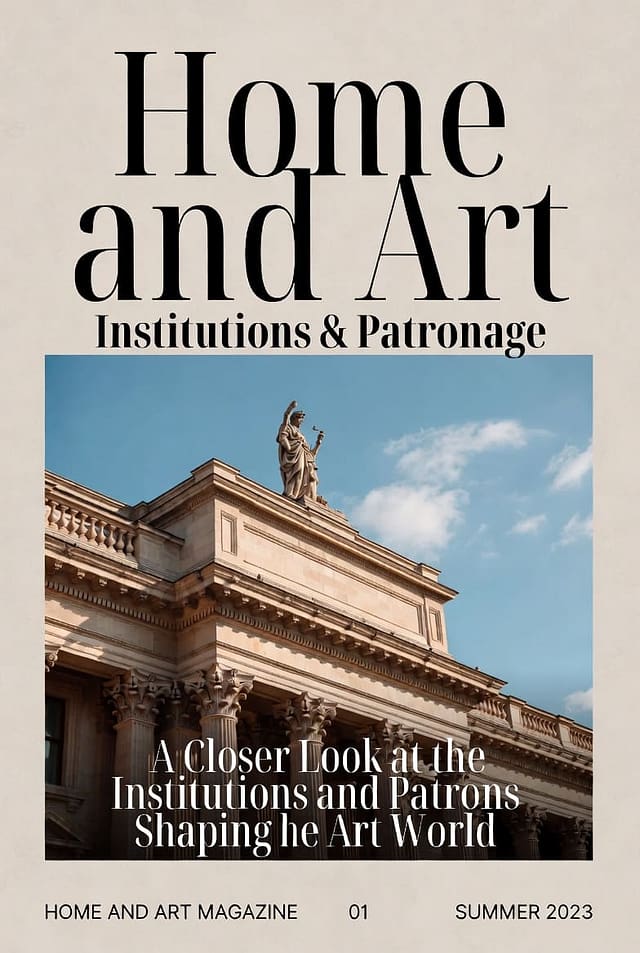
Institutions & Patronage: Sustaining Creativity in the Realm of Home and Art
In the intricate dance between art and society, institutions and patronage stand as enduring choreographers, guiding the creation, preservation, and dissemination of aesthetic expressions that permeate our homes. From royal commissions that birthed Renaissance masterpieces to modern foundations funding avant-garde installations, these mechanisms have shaped how art enters domestic spaces—transforming walls into galleries, furniture into sculptures, and everyday objects into heirlooms. This narrative uncovers the symbiotic relationship between institutional support and private patronage, exploring their historical evolution, cultural impacts, and future trajectories. Through tales of visionaries and collectives, we reveal how these forces not only sustain artists but also democratize art, making it an integral thread in the fabric of home life, where beauty meets belonging.
Ancient Foundations: Temples, Kings, and Civic Pride
The roots of artistic patronage trace to antiquity, where institutions—often intertwined with religion and state—commissioned works that blurred public grandeur with private reverence. In ancient Egypt, pharaohs like Ramses II acted as divine patrons, funding colossal temples adorned with bas-reliefs depicting conquests and rituals. These artworks, later echoed in household shrines with smaller statuettes, served as records of legacy, bringing institutional patronage into intimate spaces. Homes of the elite featured faience tiles and painted ostraca, subsidized by temple workshops, illustrating how state institutions funneled resources to artisans, ensuring art’s role in daily spiritual life.
Mesopotamian city-states advanced this model, with kings like Hammurabi patronizing cylinder seals and ziggurat friezes that documented laws and myths. Civic institutions, such as guilds in Sumer, trained craftsmen whose works—ivory carvings and lapis lazuli inlays—adorned merchant homes, blending commerce with creativity. In Greece, the polis emerged as a collective patron: Athens’ Periclean building program, funded by the Delian League, produced the Parthenon sculptures, fragments of which inspired domestic pottery and mosaics. Private patrons, like wealthy symposiasts, commissioned red-figure vases by artists such as Euphronios, depicting symposia that mirrored home entertainments, thus personalizing institutional aesthetics.
Rome amplified patronage through emperors and senators. Augustus’ Ara Pacis, an institutional altar celebrating peace, influenced villa frescoes in Pompeii, where patrons like the Vettii brothers hired painters to record banquets and myths on walls. The Senate’s endowments for public baths and forums trickled into homes via affordable terracotta replicas, democratizing art. These early systems highlight patronage as a bridge: institutions provided scale and resources, while patrons infused personal narratives, embedding art in the hearth as symbols of status and solace.
Medieval Guilds and Ecclesiastical Might: Faith-Fueled Support
The Middle Ages saw institutions dominate patronage amid feudal hierarchies, with the Church as the preeminent force. Monasteries and cathedrals functioned as artistic hubs, commissioning illuminated manuscripts and stained glass that narrated biblical tales. Patrons like Charlemagne endowed scriptoria, producing works like the Lindisfarne Gospels, whose intricate designs influenced noble homes’ tapestries and reliquaries. Guilds—medieval institutions regulating crafts—ensured quality, training apprentices in goldsmithing and weaving, their outputs gracing burgher residences with altarpieces and embroidered hangings.
Secular patronage flourished under monarchs and merchants. The Medici family in Florence exemplified this, banking fortunes funding artists like Donatello, whose bronze David adorned their palazzo, symbolizing civic humanism. Institutional bodies like the Florentine Arte della Lana (wool guild) sponsored public works, such as Brunelleschi’s dome, inspiring domestic architecture with scaled-down cupolas and frescoes. In Northern Europe, the Burgundian court patronized van Eyck’s oil paintings, rich in symbolism, which filtered into merchant homes as devotional diptychs.
This era’s patronage often intertwined piety with power: ecclesiastical institutions provided moral frameworks, while private patrons sought immortality through art. Homes became extensions of this, with commissioned portraits and heraldry turning domestic spaces into personal museums, preserving lineage amid uncertainty.
Renaissance to Enlightenment: Courts, Academies, and Bourgeois Backers
The Renaissance marked a patronage renaissance, with institutions formalizing support through academies. Florence’s Platonic Academy, backed by the Medici, nurtured thinkers like Ficino, influencing art like Botticelli’s Primavera, destined for villa walls. Papal patronage in Rome funded Michelangelo’s Sistine Chapel, elements of which echoed in patrician homes’ ceiling illusions. Private collectors like Isabella d’Este amassed cabinets of curiosities, blending institutional grandeur with intimate displays.
The Baroque period saw absolutist courts as mega-institutions: Versailles under Louis XIV employed artists like Le Brun for opulent interiors, inspiring aristocratic chateaus with gilded mirrors and tapestries. Academies like France’s Académie Royale standardized training, producing works for bourgeois patrons who filled salons with Watteau’s fêtes galantes, capturing enlightened leisure.
The Enlightenment democratized patronage via salons and subscriptions. Institutions like the Royal Academy in London, founded by George III, exhibited works accessible to the public, influencing home decor with affordable prints by Hogarth, satirizing domestic follies. Philanthropic patrons, such as the Rothschilds, supported emerging talents, bringing Romantic landscapes by Turner into drawing rooms, where art fostered intellectual discourse.
These centuries shifted patronage from elite exclusivity to broader access, with institutions professionalizing art while patrons personalized it, embedding emotional depth in home aesthetics.
Modern Dynamics: Museums, Foundations, and Corporate Collectors
The 19th and 20th centuries industrialized patronage, with museums emerging as key institutions. The Louvre, nationalized post-Revolution, preserved masterpieces, inspiring private collections like those of the Rockefellers, who donated to MoMA. Foundations like Guggenheim funded abstract expressionists—Pollock’s drips adorning modern lofts, turning homes into extensions of institutional visions.
Corporate patronage rose: IBM commissioned Eames furniture, blending design with functionality for mid-century homes. Government institutions, via New Deal programs, supported muralists like Orozco, whose works influenced public housing art. Philanthropists like Peggy Guggenheim patronized surrealists, her Venice palazzo becoming a museum-home hybrid.
Contemporary patronage diversifies: institutions like the Getty Trust preserve while funding digital art, accessible via home screens. Crowdfunding platforms democratize support, enabling artists like Banksy to create street art reproduced in domestic prints. Tech moguls like Elon Musk back space-inspired designs, infusing homes with futuristic sculptures.
Challenges persist—inequities in funding, cultural biases—but patronage evolves, with NFTs and blockchain enabling micro-patronage, where collectors own digital records displayed in virtual homes.
Future Prospects: Inclusive Ecosystems and Global Networks
Tomorrow’s patronage may leverage AI and global networks, with institutions like virtual museums curating personalized experiences. Foundations could fund sustainable art—recycled installations for eco-homes—while patrons use VR to commission immersive works. Decentralized autonomous organizations (DAOs) might crowdsource support, blurring lines between institution and individual.
Yet, core truths endure: patronage sustains innovation, institutions provide structure. In homes, this manifests as curated spaces where art records life’s mosaic, fostering connection across eras.
In weaving institutions and patronage into home and art, we honor creativity’s guardians, ensuring beauty’s legacy thrives.
Delve deeper with our explorations of Renaissance masters or modern museum influences.
