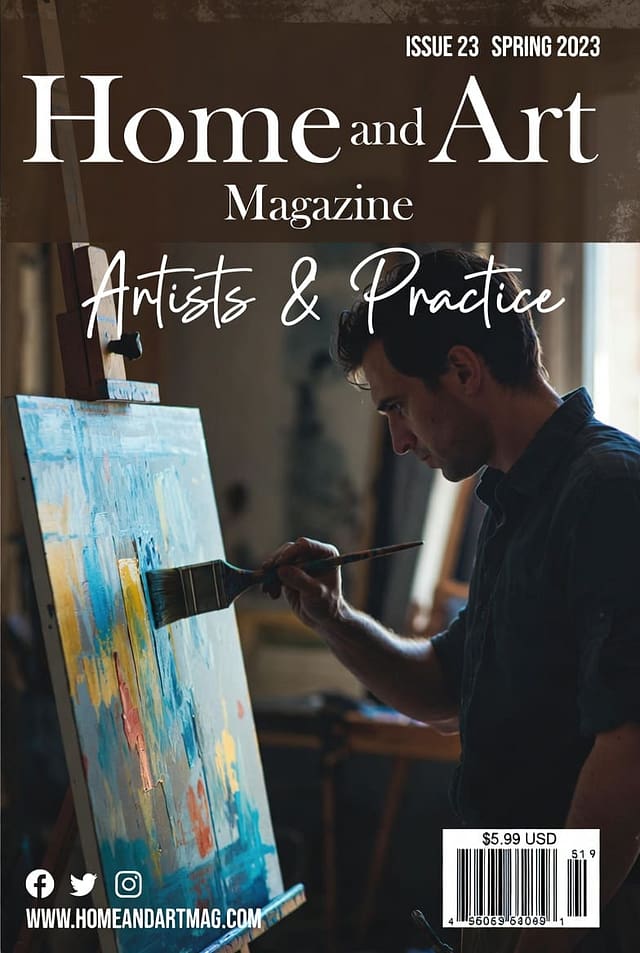
Artists & Practice: The Work Behind the Work
Home is where practice becomes visible. Art is where practice becomes legible.
The real story is practice—the daily, invisible sequence of choices that turns attention into form. Practice is not merely “process.” It is an ethics of making.
It is how an artist learns what to repeat, what to resist, what to discard, what to preserve.At Home & Art, we cover artists not as personalities, and not as producers of luxury, but as builders of meaning—people who train their perception until it becomes a tool the rest of us can borrow.
We are interested in the conditions that make practice possible: time, space, materials, education, mentorship, and the quiet infrastructure of a life devoted to making.
The studio is not a romantic myth. It is a working environment with costs, constraints, and consequences.“Artists & Practice” is our commitment to telling that fuller story: how artists work, what their work is made from, and what it asks of the world that receives it.
Not trend coverage. Not product coverage. A record of how attention becomes culture.
Practice Is a Place
Practice is inseparable from environment. Light changes decisions. Noise changes concentration. Rent changes scale. Climate changes materials.
Even the layout of a home can shape whether an artist has an hour of uninterrupted thinking or none at all.
This is why we treat domestic space and studio space as part of the same system: the built world either protects practice or erodes it.
Consider the tradition of the atelier—workshops where skill is transmitted through repetition, critique, and craft lineage
(atelier).
Or the Bauhaus, which refused to separate art from making and trained artists to think through material and industry
(Bauhaus).
Or Black Mountain College, where experimental pedagogy treated art as a way of living, not a specialty
(Black Mountain College).
Each of these was not just an idea—it was a physical arrangement of people, tools, time, and shared attention.
We are drawn to artists who understand this truth in their bones: that practice requires architecture, even if it happens at a kitchen table.
To document practice is to document the rooms that allow it.
What We Look For When We Cover Artists
We are less interested in what an artist claims to be doing than in what their practice proves over time. In every feature, we look for:
- Material intelligence: what the work is made of, where those materials come from, and what they cost the world.
- Method: the repeatable habits that turn inspiration into structure—sketching, iteration, failure, revision, constraint.
- Lineage: who taught them, who they study, and what traditions they are extending, repairing, or refusing.
- Place: how geography, housing, studio access, and community shape the work’s scale and sensibility.
- Consequence: what the work changes—perception, memory, power, belonging.
This approach is intentionally slower than the market. We do not treat the artist as content. We treat the artist as a thinker whose medium is form.
The point is not to flatten complexity into a “look.” The point is to make the reader fluent in how the work was earned.
Craft, Labor, and the Ethics of Beauty
Beauty can be a refuge, but it can also be a cover story—especially when it hides extraction, underpaid labor, and ecological harm.
To write seriously about artists and practice, we have to write about labor. We have to ask who made what, under what conditions, and for whose benefit.
The Arts and Crafts movement argued—imperfectly but powerfully—that objects hold moral and social meaning, and that the dignity of making matters
(Arts and Crafts movement).
Today that question is sharper, not softer. Materials travel farther. Supply chains are more opaque. The climate ledger is more urgent.
“Practice” includes the unseen practices behind the work: sourcing, production, disposal, repair.
When we publish, we will ask artists about their materials with the same seriousness we ask them about their ideas—because ideas do not exist without matter.
The most timeless work is rarely weightless. It is accountable.
Time, Attention, and the Deep-Work Economy
One of the great hidden crises of contemporary life is the collapse of uninterrupted attention.
Practice depends on long stretches of thought. But the architecture of the internet—notifications, feeds, metrics—was not designed to protect contemplation.
The result is a culture that consumes images faster than it can interpret them.
We want to write in a way that restores time to the reader. Our stories will be readable, structured, and clear—because accessibility is not a compromise; it is a public service.
We will publish work that assumes intelligence without demanding jargon. We will let artists speak in their own language, then translate the stakes into common speech.
Clarity is how meaning travels.
This is also where our Pulitzer-level intention lives: not in prestige, but in standards. Reporting that respects facts. Writing that respects readers.
Editing that respects complexity without turning it into fog.
Practice as a Cultural Signal
Artists are often treated as decorators of the present. We see them as interpreters of it. Their practice registers what a society can’t quite say directly.
In that sense, art is not separate from architecture; it is architecture’s inner life. It reveals what spaces are doing to us—emotionally, politically, spiritually.
Think of the way Louise Bourgeois turned memory into structure,
or how Agnes Martin made attention itself into a medium,
or how Gordon Matta-Clark treated buildings as arguments you could cut open.
You do not need to “like” these works to learn from their practices. You only need to notice what they make newly visible.
This is the kind of coverage we believe lasts: stories that teach readers how to see, not what to buy. Stories that can be revisited because they are not anchored to novelty,
but to observation.
How We Will Tell These Stories
“Artists & Practice” will move across formats—profile, criticism, studio visits, material essays, and field reports from workshops and residencies.
We will pair world-class imagery with reporting that does not treat visuals as an ending, but as an opening.
Over time, we will also explore immersive and spatial storytelling—not as spectacle, but as a tool for understanding how art and architecture are felt in the body.
Our advertising model will never interrupt reading. Ads will live around the story, not on top of it. The experience will remain calm by design,
because practice requires calm—and so does deep reading.
A Standard Worth Keeping
We believe the most meaningful cultural journalism is not “cutting edge.” It is enduring. It gathers evidence, contextualizes it, and returns the world to the reader with more clarity than before.
In that spirit, we will approach every artist and every practice with the same seriousness: as a living archive of how humans make meaning in time.
If architecture answers how we live together, and art answers why it feels the way it does, then “Artists & Practice” is where those truths meet—inside the days, the rooms, and the
disciplines that make the work possible.
