
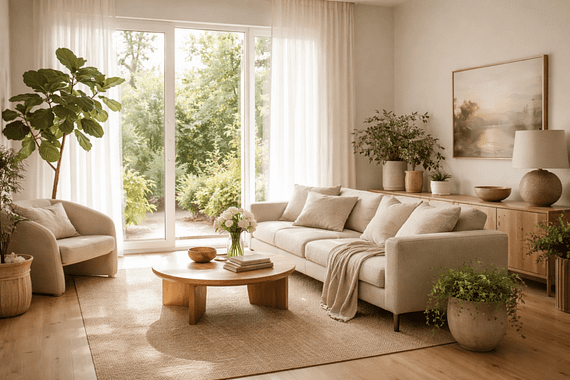
Why the spaces we live in are either calming us down—or quietly wearing us out
Most people think of their home as shelter.
A roof. Walls. A place to keep things.
But that’s not how your brain experiences it.
Your home is more like a nervous system—constantly sending signals about safety, stress, control, and rest. You don’t consciously hear those signals, but your body does. And it responds all day long.
If you’ve ever felt inexplicably tense in a beautiful space, or deeply calm in a modest one, this is why.
Your Brain Is Always Listening
The human brain evolved to scan environments for danger and safety. Long before décor or design trends, it asked simpler questions:
-
Can I see clearly?
-
Can I rest my eyes?
-
Is it loud or quiet?
-
Do I feel contained or exposed?
Modern homes answer these questions constantly—through light, sound, layout, and clutter.
Environmental psychology research has shown that visual chaos, harsh lighting, and persistent noise subtly elevate stress hormones, even when we “get used to them.” The body never fully adapts; it compensates.
This is why fatigue can feel mysterious.
It’s not always your workload.
Sometimes it’s your walls.
(Research synthesized by American Psychological Association and environmental design studies from National Institutes of Health.)
Why Some Homes Exhaust Us
A home doesn’t have to be ugly to be overwhelming.
Common stressors include:
-
Inconsistent lighting that keeps the brain alert when it should wind down
-
Hard surfaces that amplify sound
-
Open layouts with no visual boundaries
-
Constant micro-decisions caused by clutter
Each one adds a small cognitive load. Together, they create a low-grade hum of alertness that never fully shuts off.
Designers sometimes call this “visual noise.” Neuroscientists call it unresolved stimulus.
Either way, your nervous system pays the price.
Calm Is Not a Style—It’s a Signal
Here’s the important simplification:
Calm is not about minimalism, luxury, or trend.
It’s about predictability and permission to rest.
A calming home usually has:
-
Clear sightlines (your eyes know where to land)
-
Soft transitions between spaces
-
Materials that absorb, not reflect, sound
-
Lighting that follows the rhythm of the day
This is why people often feel better in older homes, libraries, or well-loved spaces. They weren’t designed to impress—they were designed to hold people.
Architectural research from institutions like Harvard Graduate School of Design consistently shows that environments with legible structure reduce cognitive stress, regardless of aesthetic style.
Art as a Regulator, Not Decoration
Art plays a surprising role in this system.
Not because it’s expensive or fashionable—but because it slows the brain down.
A single piece of art can:
-
Give the eye a place to rest
-
Interrupt visual clutter
-
Create emotional grounding
Museums have known this for decades. Studies cited by The British Museum and The Museum of Modern Art show that focused visual engagement lowers stress and increases feelings of meaning.
At home, art works the same way—quietly and personally.
Why This Matters More Now
We live in a world of constant input:
-
Notifications
-
News cycles
-
Screens in every room
When the outside world gets louder, the home must do more work.
This is one reason people are rethinking where—and how—they live. Migration away from dense, overstimulating environments isn’t just about cost or space. It’s about nervous-system relief.
Urban studies from Brookings Institution and population research from U.S. Census Bureau show a growing preference for environments that feel manageable, not maximal.
People aren’t downsizing ambition.
They’re downsizing noise.
A Simple Test
If you’re unsure whether your home is supporting you, try this:
Sit quietly in one room for two minutes.
No phone. No task.
Ask yourself:
-
Do my eyes know where to rest?
-
Does my body soften—or stay alert?
-
Do I feel held, or exposed?
Your answer is more honest than any design trend.
The Quiet Truth
A good home doesn’t demand attention.
It gives it back.
When a space works, you don’t notice it doing its job. You just feel clearer. Kinder. Less rushed.
That’s not an accident.
That’s a nervous system finally allowed to exhale.
And in a loud world, that may be the most important form of design there is.
