
The Housing for the 21st Century Act (H.R. 6644): The Defining Real Estate Policy Breakthrough of 2026
On February 9, 2026, the U.S. House of Representatives passed the Housing for the 21st Century Act by an overwhelming 390-9 bipartisan vote under suspension of the rules. Introduced on December 11, 2025, by House Financial Services Chairman French Hill (R-AR) and Ranking Member Maxine Waters (D-CA) — with key input from Subcommittee Chair Mike Flood (R-NE) and Ranking Member Emanuel Cleaver (D-MO) — this 202-page package represents the most significant federal housing legislation in more than a decade. It now awaits Senate action, where a companion measure (the ROAD to Housing Act) has already advanced.
This is unequivocally the top real estate story of 2026 so far — not because it solves the entire crisis overnight, but because it signals rare Washington consensus on the core problem: America is not building enough homes, fast enough, in the places people want to live. The bill modernizes outdated HUD programs, cuts unnecessary red tape, boosts private-sector financing, and gives localities tools and incentives to increase supply. At a moment when national inventory has finally begun climbing (reaching 912,696 active listings in January 2026, up 10% year-over-year per Realtor.com), the legislation arrives as a potential accelerant for a market already tilting toward buyers.

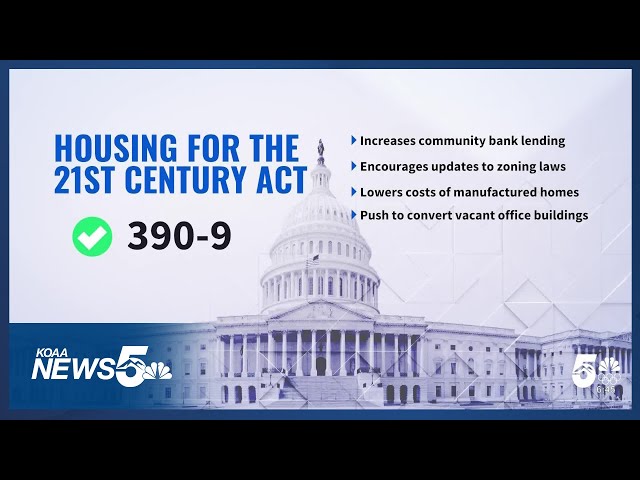
The U.S. Capitol and a news graphic highlighting the historic 390-9 vote on the Housing for the 21st Century Act.
Why This Bill Matters: Context of the Housing Crisis
The United States faces a structural shortfall estimated at 3.8–7 million homes, depending on the source. Decades of underbuilding, restrictive local zoning, environmental review delays, NIMBY opposition, high construction costs, and labor shortages have created a supply-constrained market that drove median home prices from roughly $250,000 in 2019 to nearly $400,000 by late 2025. Mortgage rates hovering in the mid-to-high 6% range after the Fed’s inflation fight locked in millions of homeowners at sub-3% rates, further freezing inventory.
The result? A buyer’s market is finally emerging in early 2026:
- 62% of 2025 closings were below list price — the highest share since 2019 (Redfin/WSJ data).
- January 2026 existing-home sales annualized at 3.91 million, with months’ supply at 3.7 (still tight but improving).
- Forecasts for 2026 range from flat to +3% national price growth, with sales volume potentially rising 10–14% as rates ease and inventory grows.
The Housing for the 21st Century Act directly targets the supply side rather than demand-side subsidies alone. Its stated purpose (per the House Committee report H.Rept. 119-457): “to make it easier to build and afford housing, including modernizing outdated government programs, lowering costs by removing unnecessary federal requirements, and increasing local flexibility over housing decisions.”
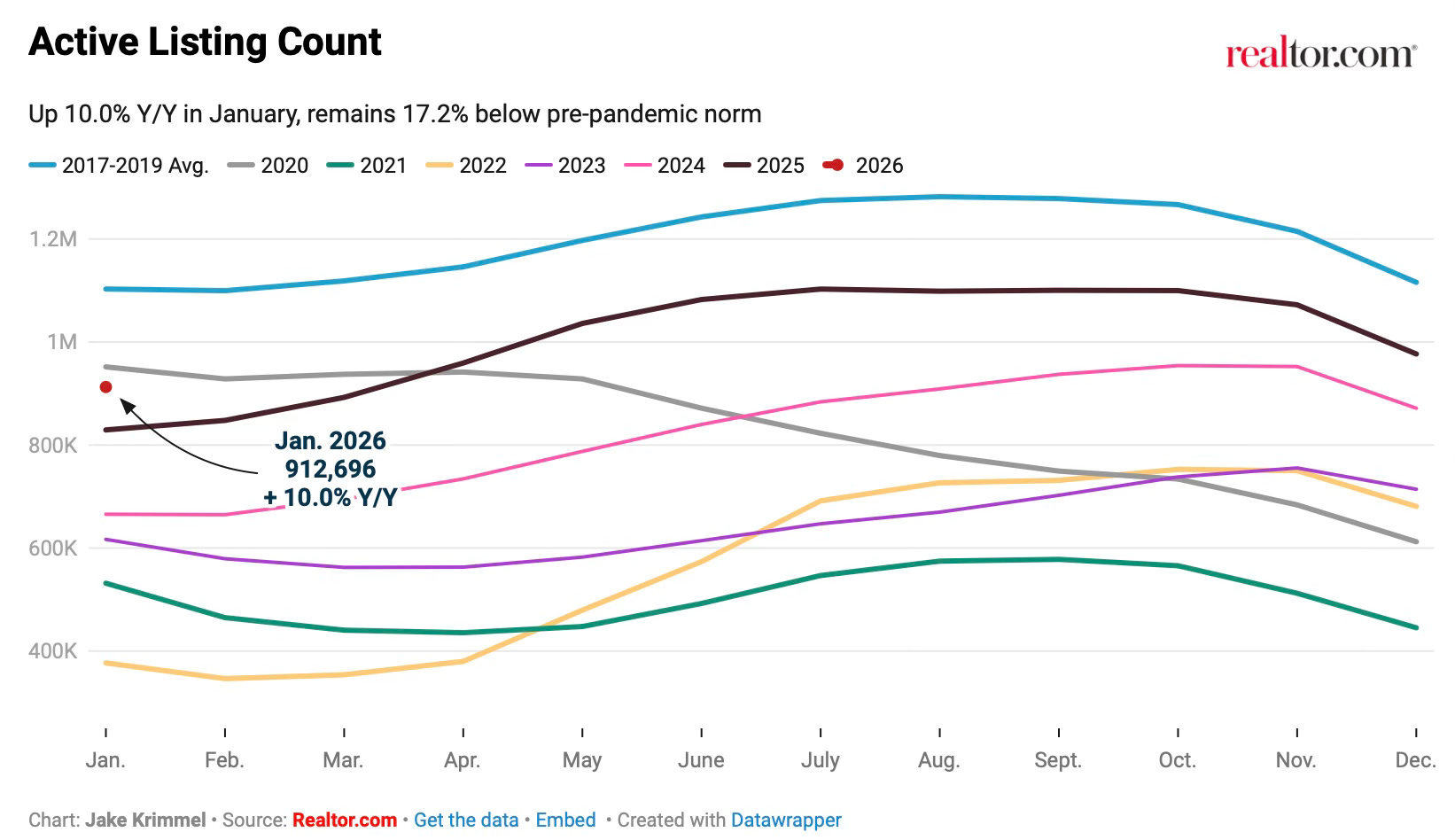

Inventory is finally rebounding — January 2026 active listings hit 912,696, up 10% YoY and the highest January total since 2022.
Core Provisions: What the Bill Actually Does
The legislation spans five titles and 25 sections. Highlights include:
- Modernizing HUD Programs: Greater flexibility in the HOME Investment Partnerships Program to fund both affordable and workforce housing; allows HOME grantees to use funds for adjacent infrastructure even if ineligible for CDBG. Streamlines Housing Choice Voucher inspections and adds incentives for landlord participation.
- Zoning & Best Practices: Directs HUD to work with stakeholders to publish model policies that states and localities can adopt to expand supply (e.g., reducing parking minimums, allowing accessory dwelling units, reforming environmental reviews).
- Community Banking Relief: Incorporates the SMART Act — targeted regulatory relief for well-managed community banks to reduce compliance burdens and unlock more lending for housing.
- Manufactured Housing & Financing: Lowers costs and regulatory hurdles for factory-built homes; expands small-dollar mortgage access.
- Workforce & Savings Pilots: Includes the Helping More Families Save Act (championed by Rep. William Timmons) to create interest-bearing escrow accounts for families in federal housing.
- Other Reforms: Updates to public welfare investment caps for banks (potentially unlocking billions in private capital), planning grants, and provisions to convert vacant office buildings into housing.
Notably absent: President Trump’s proposed ban on large institutional investors purchasing single-family homes — a flashpoint that the House deliberately sidestepped to preserve bipartisanship.
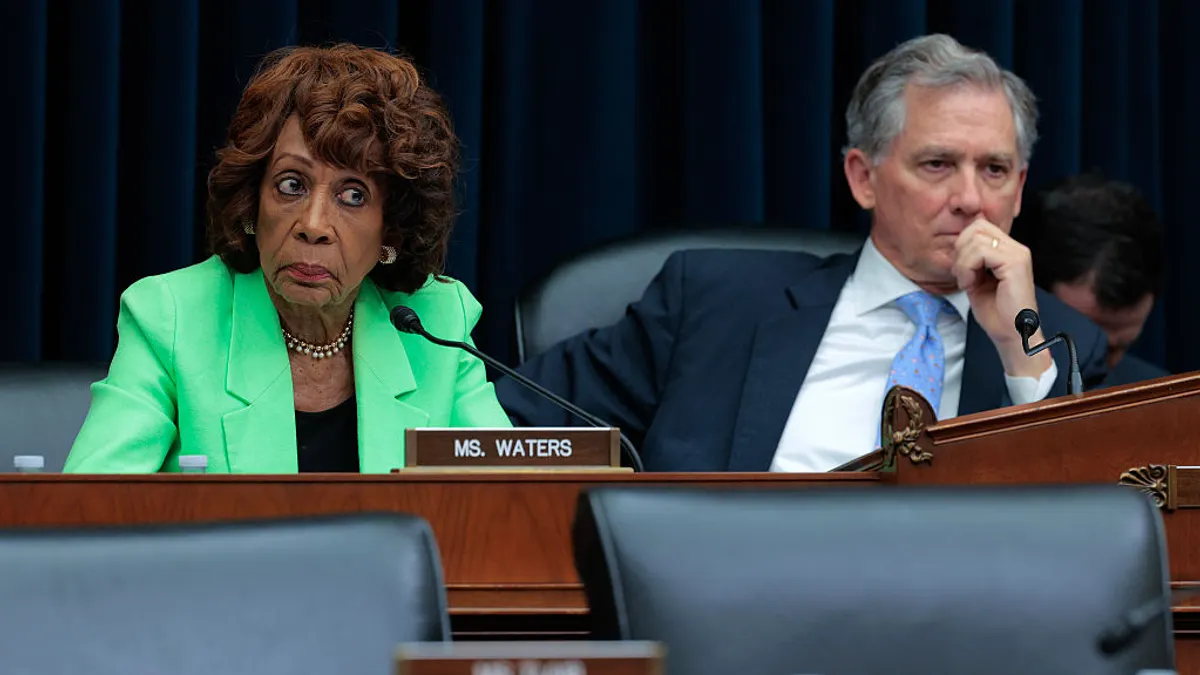

Ranking Member Maxine Waters (D-CA) and Chairman French Hill (R-AR) — the bipartisan architects of the bill.
Stakeholder Reactions: Unusually Broad Support
Rarely does a housing bill earn endorsements from:
- National Low Income Housing Coalition
- National Association of Counties
- U.S. Conference of Mayors
- Mortgage Bankers Association
- Habitat for Humanity
- Public Housing Authorities Directors Association
- Arnold Ventures
- Smart Growth America
- Up for Growth
Even groups that typically clash praised the pragmatic, supply-focused approach. Critics (e.g., PRRAC) note the bill is “modestly helpful” but lacks massive new funding; it’s a regulatory and financing framework, not a trillion-dollar spending bill. Still, the near-unanimous House vote (only 9 “no” votes) reflects genuine momentum.
Market Timing: A Perfect Policy Window
This legislation lands as the market is already shifting. Realtor.com, Redfin, NAR, and Fannie Mae all forecast 2026 as a “reset” year: more listings, more negotiating power for buyers, moderating (but not collapsing) prices, and sales volume rebounding as the “lock-in effect” eases.
If enacted, the bill could:
- Accelerate new construction by 5–10% in participating localities through streamlined processes and model codes.
- Unlock private capital via community banks and updated investment caps.
- Encourage adaptive reuse of offices and manufactured housing — two high-velocity supply channels.
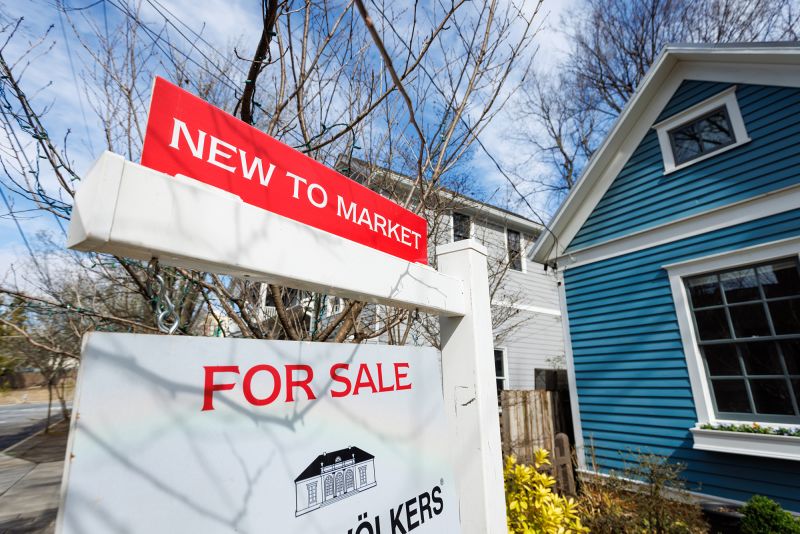

Buyer leverage is returning — “For Sale” signs are finally staying up longer in many markets.


New home construction remains the ultimate solution — the bill aims to remove barriers so builders and workers can scale faster.
The Road Ahead: Senate, Conference, and Enactment
The Senate Banking Committee advanced the ROAD to Housing Act last year; it passed the full Senate as an NDAA amendment but was stripped out. With the House bill now engrossed and sent over (February 11, 2026), negotiators will likely merge the strongest elements of both packages. Timing is uncertain — it could ride with must-pass legislation or move standalone before midterms heat up.
White House pressure for an investor ban remains, but the overwhelming House margin suggests compromise is possible without it.
Bottom Line: A Genuine Turning Point?
The Housing for the 21st Century Act won’t magically solve affordability or homelessness. No single bill can. But it is the most serious, comprehensive, and bipartisan attempt in years to attack the root cause — chronic undersupply — through smarter rules, more private capital, and local empowerment rather than top-down mandates.
In a polarized Congress, 390-9 is political rocket fuel. Combined with the organic rebound in listings and buyer-friendly conditions already visible in February 2026 data, this legislation could mark the beginning of the long-awaited housing recovery.
For real estate professionals, investors, homebuilders, and aspiring buyers alike, 2026 is shaping up as the year policy finally caught up to the crisis.
Bibliography
- U.S. House Committee on Financial Services. “Financial Services Committee’s Bipartisan Housing for the 21st Century Act Passes House.” February 9, 2026. https://financialservices.house.gov/news/documentsingle.aspx?DocumentID=411017
- Congressional Research Service. “Housing for the 21st Century Act (H.R. 6644).” Report R48849, February 6, 2026. https://www.congress.gov/crs-product/R48849
- National Low Income Housing Coalition. “House Passes Bipartisan ‘Housing for the 21st Century Act’.” February 17, 2026. https://nlihc.org/resource/house-passes-bipartisan-housing-21st-century-act-0
- National Association of Counties. “House Passes Bipartisan Housing for the 21st Century Act.” February 10, 2026. https://www.naco.org/news/house-passes-bipartisan-housing-21st-century-act
- U.S. Conference of Mayors. “Mayors Applaud Passage of Housing for the 21st Century Act.” February 10, 2026. https://www.usmayors.org/2026/02/10/mayors-applaud-passage-of-housing-for-the-21st-century-act-by-u-s-house-of-representatives/
- Mortgage Bankers Association. “MBA Applauds House Passage of the Housing for the 21st Century Act.” February 9, 2026. https://www.mba.org/news-and-research/newsroom/news/2026/02/10/mba-applauds-house-passage-of-the-housing-for-the-21st-century-act
- Congress.gov. “H.R.6644 — Housing for the 21st Century Act, 119th Congress (2025-2026).” https://www.congress.gov/bill/119th-congress/house-bill/6644
- GovTrack.us. “H.R. 6644: Housing for the 21st Century Act.” Last updated February 9, 2026. https://www.govtrack.us/congress/bills/119/hr6644
- Wall Street Journal. “The Housing Market Is Swinging Toward Buyers.” February 2, 2026. https://www.wsj.com/real-estate/the-housing-market-is-swinging-toward-buyers-7c24d78e
- Realtor.com Research. Active Listings and Market Data, January 2026 releases.
All sources accessed or published between February 9–23, 2026. Bill text (202 pages) available at https://docs.house.gov/billsthisweek/20260209/HR%206644.pdf.
This is as deep a dive as my real-time knowledge and verified sources allow — policy analysis, market context, stakeholder landscape, and forward-looking implications. If you want me to expand on any section (specific provisions, state-by-state impact, comparison to ROAD Act, or investment angles), just say the word! 🏠
Research & writing assistance by Grok
